We do not present BTCUP·BTCDOWN as a way to make new purchases on Binance today. Binance announced the termination of its leveraged token services in 2024. The search phrase “Binance ETF” should be distinguished from ETFs listed on securities exchanges and from the former Binance Leveraged Tokens.
Correction and re-verification: October 29, 2026 (Korea Standard Time). This page is an explanatory resource that revises the previous present-tense trading instructions and unverified personal performance table. Coinpop may receive compensation when affiliate links are used, but creating an account or using a link does not guarantee eligibility to trade a particular product, discounts, or profits.
Sign up for Binance (referral discount code COINPOP)
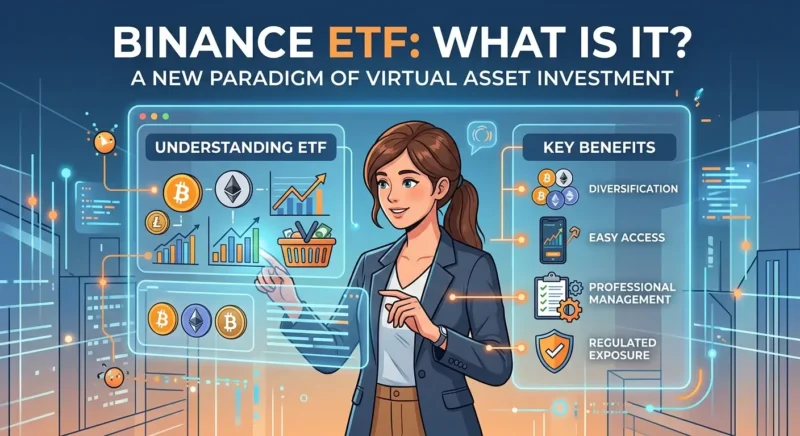
1. ETFs and former exchange leveraged tokens are not the same product
First, identify which security or token you are dealing with and in which market. An ETF is a fund share traded on an exchange, while former Binance UP/DOWN tokens cannot be classified as the same legal product. Even if their names are similar or they share an underlying asset, their issuers and operators, rights and regulatory frameworks, and trading channels differ.
| Item to check | Securities ETF | Former Binance UP/DOWN tokens |
|---|---|---|
| What to identify | Exact fund name, ticker, listing market, and prospectus | Exact token name and the exchange terms in effect at the time |
| Assessing current availability | Check the broker, region of residence, and product-specific eligibility conditions | Prioritize the 2024 termination notice; do not present these as currently purchasable |
| Costs and risks | Check product-specific fees, tracking error, currency exchange, and leverage structure | Review the management, rebalancing, and liquidity structures at the time only as historical examples |

2. Start by checking the 2024 termination notice
The official Binance account’s announcement that leveraged token services would end provides information about the suspension of trading and subscriptions, followed by delisting and the end of redemption, and names BTCUP/BTCDOWN, ETHUP/ETHDOWN, and BNBUP/BNBDOWN. We retract the previous step-by-step instructions telling readers to find and buy terminated tokens in the current Derivatives menu. Because the announcement contains inconsistent time references, this article uses only the verified termination year and product distinctions.
This historical termination alone does not justify generalizing that all current Binance tokenized assets, TradFi products, or other derivatives have also been discontinued. Conversely, do not assume that a newly named similar product is a relisting of a former token. Verify the exact issuer, product documentation, and current trading support separately.

3. Path dependency in leveraged returns: a calculation example
The following is a simple calculation for a hypothetical product that tracks exactly 2x daily—not the performance of an actual ETF or former token. Trading costs, fees, tracking error, and taxes are excluded. Assume that both the underlying asset and the hypothetical product start at 100.
| Period | Underlying asset | Hypothetical product assuming 2x daily returns |
|---|---|---|
| Starting point | 100 | 100 |
| Day 1: +10% | 100 × 1.10 = 110 | 100 × 1.20 = 120 |
| Day 2: −10% | 110 × 0.90 = 99 | 120 × 0.80 = 96 |
| Cumulative result | −1% | −4%: differs from simply doubling the cumulative −1% |
The key is that daily returns are compounded. Even if the underlying asset returns to a similar price, the hypothetical product may not return by the same percentage. Do not use this example to claim that all leveraged tokens followed the same daily 2x rule, or as a loss probability or expected return.
The U.S. SEC’s investor bulletin also explains that the daily targets of leveraged and inverse ETFs may differ from their long-term cumulative performance. This guidance concerns securities ETFs and does not replace the individual terms of former Binance tokens.

4. Do not use unverified trading testimonials or recommended allocations
The original article did not provide trade records, measurement periods, or source data to support its claims of “six months of actual BTCUP/BTCDOWN trading,” its performance range table, star ratings, or recommended asset allocations. We do not cite these as Coinpop’s verified experience or actual returns, and have removed the related table and definitive statements.
Instead, when researching former products, distinguish the original announcement and termination dates from the timestamps, quantities, execution prices, and fees in actual trade records, as well as deposits and withdrawals, exchange rates, and the comparison benchmark. Do not fill in missing data with estimates. Do not present a fixed holding period, stop-loss percentage, or asset allocation as a safe standard for all readers.

5. Checks for users in Korea
First distinguish whether a product is a securities ETF available in Korea or a token on an overseas exchange. Access to an overseas website or the ability to search for a ticker does not, by itself, confirm eligibility based on your region of residence or protection under Korea’s domestic framework. Check the regulations, KYC requirements, and product terms, and do not circumvent restrictions.
For current exchange registration, KYC, regional requirements, and fee structures, refer to the Binance comprehensive guide. This link is not a route to purchase terminated UP/DOWN tokens. Leverage, exchange custody, and liquidity risks are distinct from the risks of managing private keys in a personal wallet.

6. Checklist for reading outdated product information
| Step | What to verify | When to stop |
|---|---|---|
| Product identification | Exact ticker, legal product type, and issuer/operator | ETF and token are not distinguished |
| Confirming support | Current official notices and actual account support | Present-tense purchase instructions that ignore a termination notice |
| Checking data | Source data, reference date, costs, and calculation assumptions | Returns, testimonials, or star ratings without sources |
| Checking eligibility | Region of residence, KYC, and product-specific conditions | Requests to use another person’s account or circumvent access restrictions |

Can I buy BTCUP·BTCDOWN now by following this article?
No. This article explains the service termination in 2024 and does not provide current purchase instructions for terminated tokens.
Are regular ETFs and exchange leveraged tokens the same?
No. You must check their trading channels, legal rights, operators, and product documentation separately. Do not treat them as identical just because their tickers or underlying assets are similar.
Are the calculations in this article actual returns?
No. This is a hypothetical daily 2x calculation that assumes a starting value of 100, followed by returns of +10% and −10%. It is an illustrative example that excludes costs and tracking error.
Existing affiliate link: Sign up for Binance (referral discount applied). Check the current eligibility and terms shown on the sign-up page. This link does not guarantee access to or discounts or profits from products that were terminated in the past.
Scope of verification: comparison of the official termination notice, product distinctions, and calculation assumptions. This is not a testimonial based on testing live-account orders or the relaunch of a current product. The original seven screen images have been preserved as historical material and are not evidence of the current UI. Author: Hyun Lee.