

The premium/discount of a spot Bitcoin ETF is the percentage showing how much the market price is above or below the net asset value (NAV) per share. However, if the market price and NAV differ in currency, valuation date, or valuation time, do not interpret the displayed premium/discount as the price difference at which you can trade right now. When reading the premium/discount, check the valuation method alongside current bid and ask quotes.
This article is an educational guide to interpreting price differences. It does not provide real-time quotes, buy signals, or information about whether trading is available in a particular account. All prices in the calculations and diagrams below are hypothetical and are not actual trading records for IBIT or any other product. Date of final verification against official sources: October 9, 2026.
Reading order: Market price and NAV → Calculating the premium/discount → Valuation time differences → Quote costs → Verification checklist.
What is the difference between market price, NAV, and the bid-ask spread?
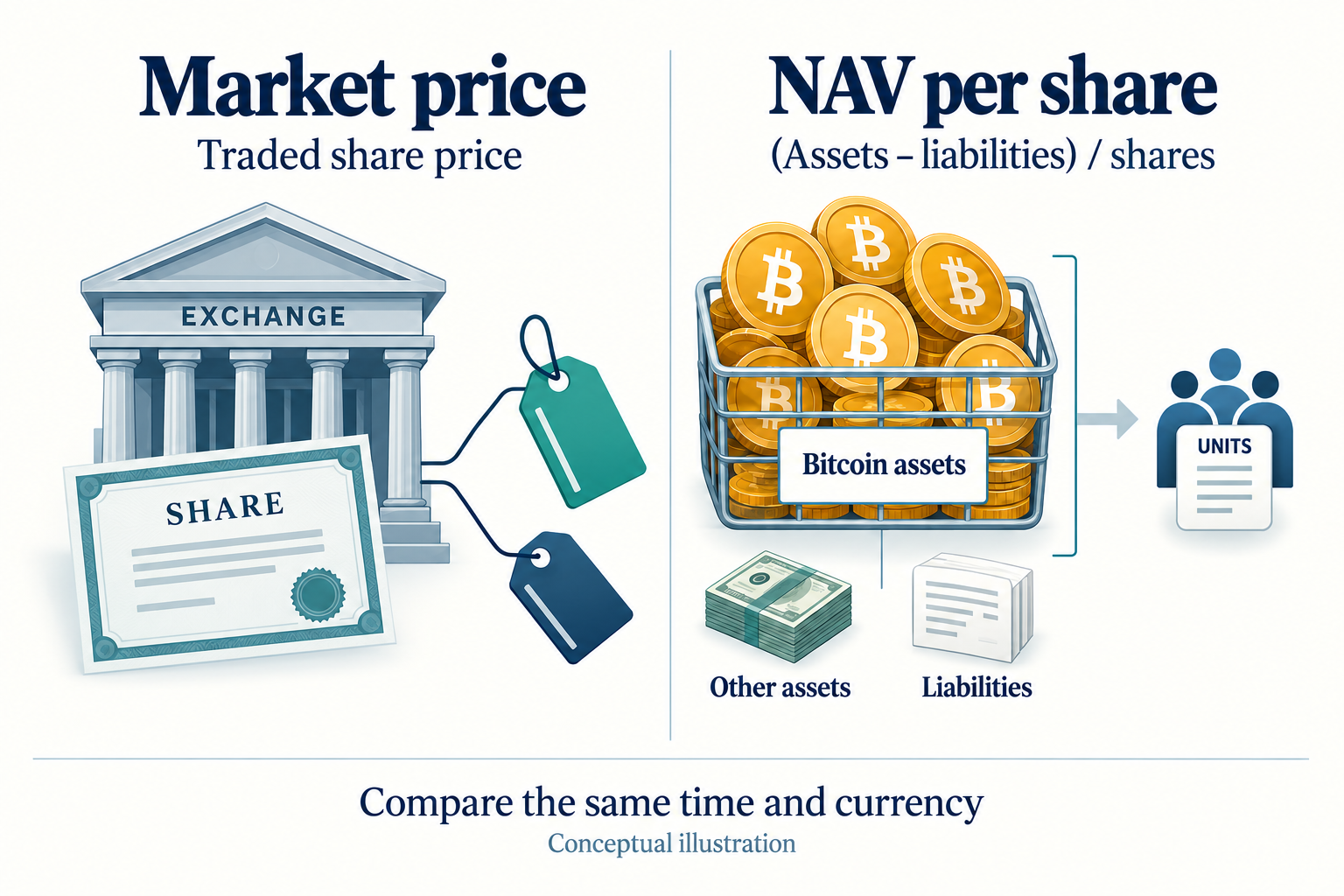
The market price is the price at which a product’s shares trade on the securities market, while NAV is the valuation obtained by dividing the product’s net assets—assets minus liabilities—by the number of shares outstanding. The bid-ask spread is the gap between the current highest bid and lowest ask. Although all three values relate to “price,” they measure different things and may refer to different points in time.
| Category | What does it show? | What to check first |
|---|---|---|
| Market price | The price of the traded product shares. The closing price, last traded price, and current quote may differ. | Trade time, exchange, and whether quotes are delayed |
| NAV per share | The valuation per share reflecting assets and liabilities | Valuation date and time, currency, and method used to determine the reference price |
| Premium/discount | The difference between the market price and NAV, expressed as a percentage of NAV | Whether the two prices being compared use the same basis |
| Bid-ask spread | The difference between the best ask and the best bid | Current quotes, displayed size, order quantity, and trading time |
Products called “spot ETFs” do not all have the same legal structure. Some U.S. spot Bitcoin exchange-traded products are structured as commodity trusts, and you should not assume they are subject to the same investor protections as ETFs under the Investment Company Act of 1940. See Investor.gov’s ETP classifications and review each product’s prospectus for its structure and risks. For more on the differences between spot, futures, and direct ownership, see Bitcoin ETF Basics and Product Structure Comparison.
How is the premium/discount of a Bitcoin ETF calculated?
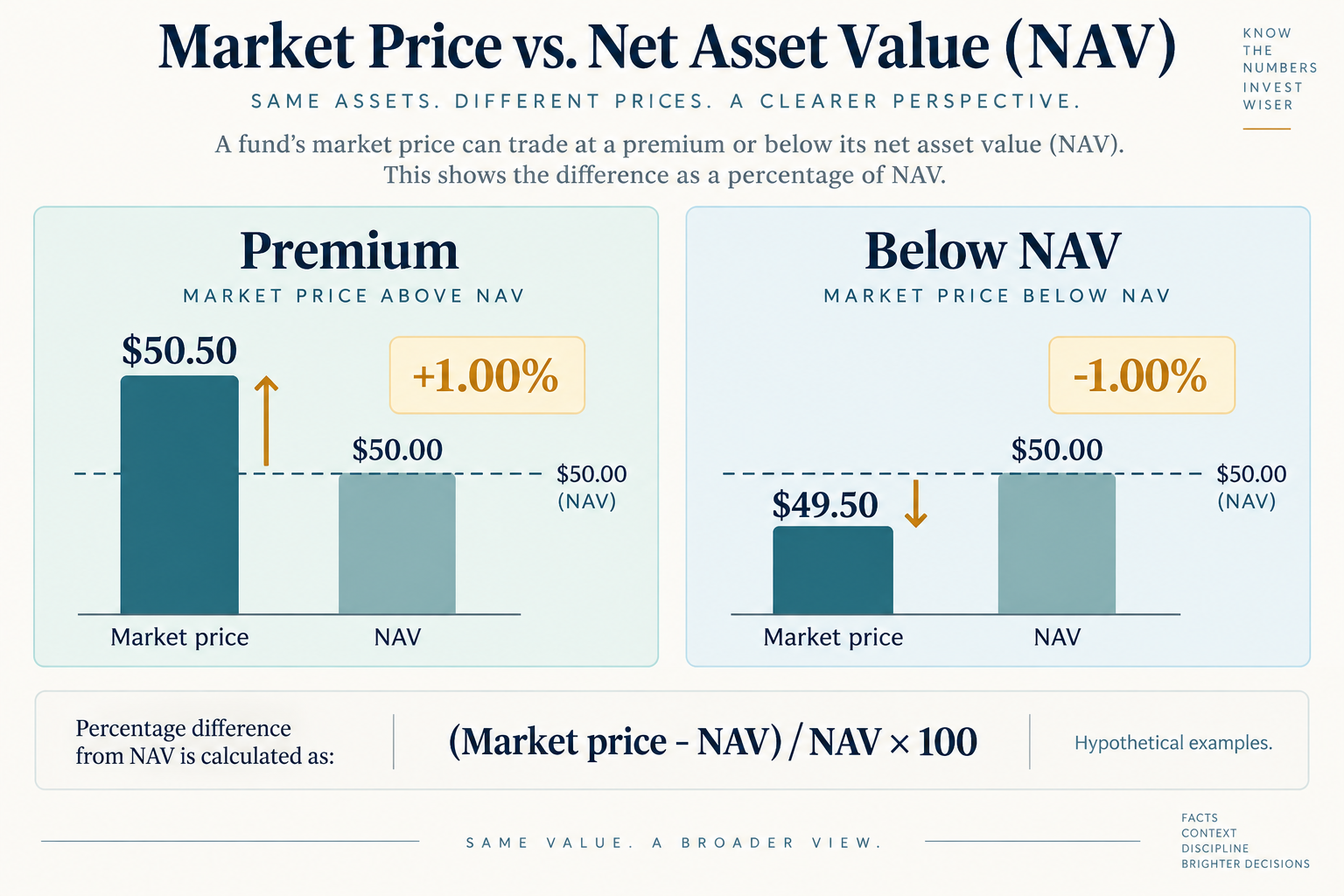
Premium/discount (%) = (market price − NAV per share) ÷ NAV per share × 100. A positive result means the market price is above NAV, at a premium; a negative result means the price is below NAV. The examples below are for educational purposes and use the same currency and comparison basis.
| Hypothetical market price | Hypothetical NAV | Calculation | Result and meaning |
|---|---|---|---|
| USD 50.50 | USD 50.00 | (50.50 − 50.00) ÷ 50.00 × 100 | +1.00%: price above NAV |
| USD 49.50 | USD 50.00 | (49.50 − 50.00) ÷ 50.00 × 100 | −1.00%: price below NAV |
Even when the calculation is correct, the interpretation can be wrong. Substituting yesterday’s NAV for today’s traded price, or directly comparing a dollar-denominated NAV with a market price in Korean won, mixes different bases. Even when checking the premium/discount published by an issuer, first determine which “market price” and which “NAV” were compared.
Why does valuation time matter even on the same day?
Bitcoin trades continuously, but the trading hours of exchange-traded products and the basis for their daily NAV valuation are set separately. Therefore, even figures for the same date need not match if one reflects prices over a one-hour period and the other is the closing price at a specific time.
According to iShares’ official explanation dated September 10, 2026, IBIT’s daily NAV uses the volume-weighted average price (VWAP) across multiple cryptocurrency exchanges from 3:00 p.m. to 4:00 p.m. Eastern Time. Other products may use different valuation methods. This example should not be treated as a rule common to all Bitcoin ETPs.
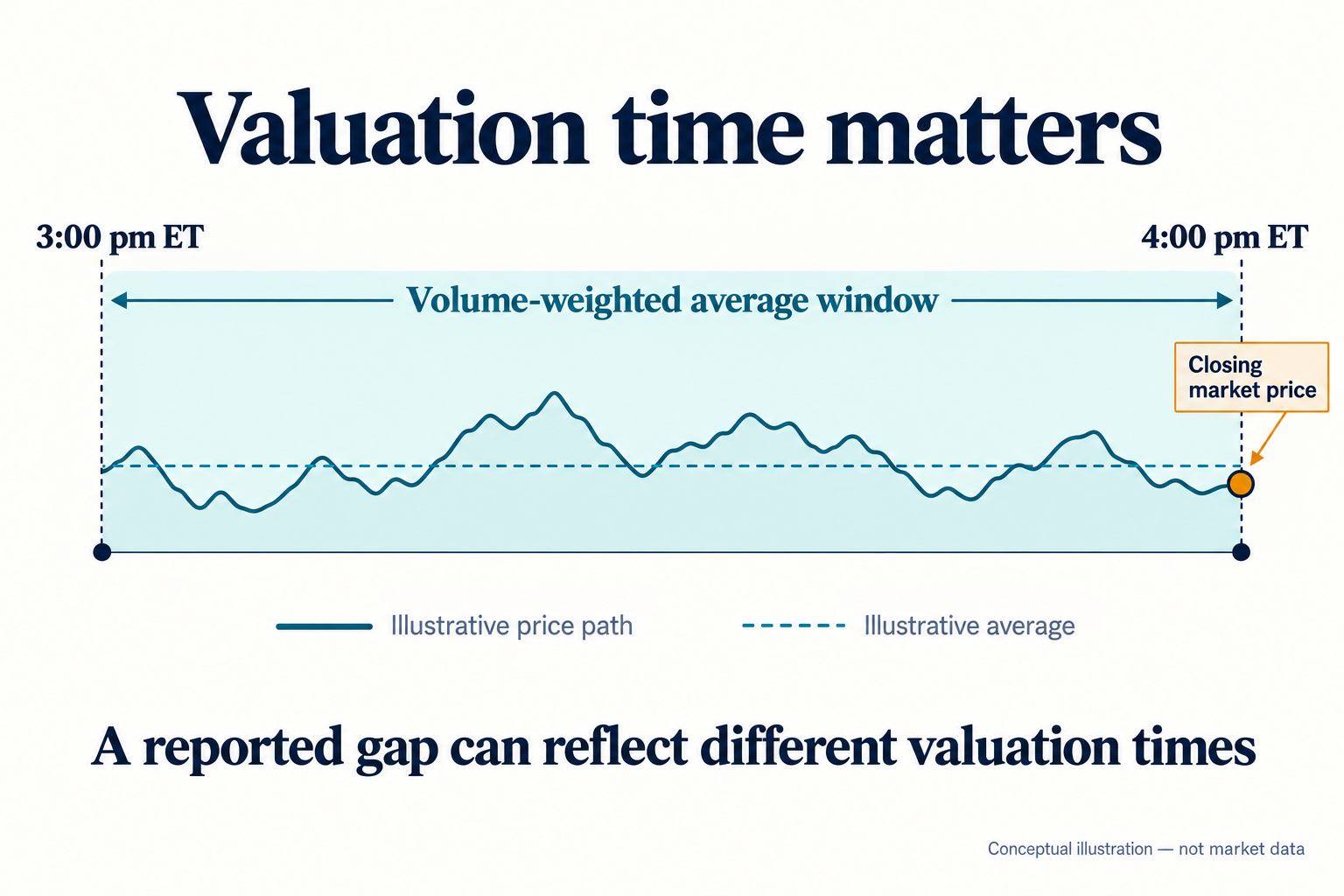
CoinPop interpretation example: If the value per share corresponding to the average valuation basis is USD 50.00 and the closing price is USD 50.50, the calculated premium/discount is +1.00%. However, you cannot conclude that it is “1% more expensive than the current value of the assets” without allowing for the possibility that the underlying asset price moved after the valuation period. This is a hypothetical example illustrating a timing mismatch, not an account of how IBIT’s actual NAV was calculated.
Conversely, not every premium or discount is caused only by differences in timing. Differences may persist because of actual supply and demand, liquidity, market operations, and limits on arbitrage. Do not determine the cause based solely on the issuer’s explanation; compare the published methodology with actual trading conditions. When converting Eastern Time to Korea Standard Time, also check whether daylight saving time applied on that date.
Quote costs can arise even when the premium/discount is small
The daily premium/discount is a comparison based on valuation, while the bid-ask spread is the gap between prices you encounter when placing an actual order. Even if the last traded price is near NAV, the price at which you can buy now may differ from the price at which you can sell. The SEC’s guide for ETF investors explains that the difference between bid and ask prices creates trading costs. The legal scope of this guidance is limited to registered ETFs; it does not replace the investor protections applicable to Bitcoin trust products.
| Hypothetical item | Value | Calculation or meaning |
|---|---|---|
| Best bid | USD 49.95 | Price to consider when selling immediately |
| Best ask | USD 50.05 | Price to consider when buying immediately |
| Midpoint of bid and ask | USD 50.00 | (49.95 + 50.05) ÷ 2 |
| Spread | USD 0.10 | 50.05 − 49.95 |
| Spread relative to the midpoint | 0.20% | 0.10 ÷ 50.00 × 100 |
| Buy and then sell 100 shares immediately | USD 10.00 difference | Buy for USD 5,005.00 − sell for USD 4,995.00 |
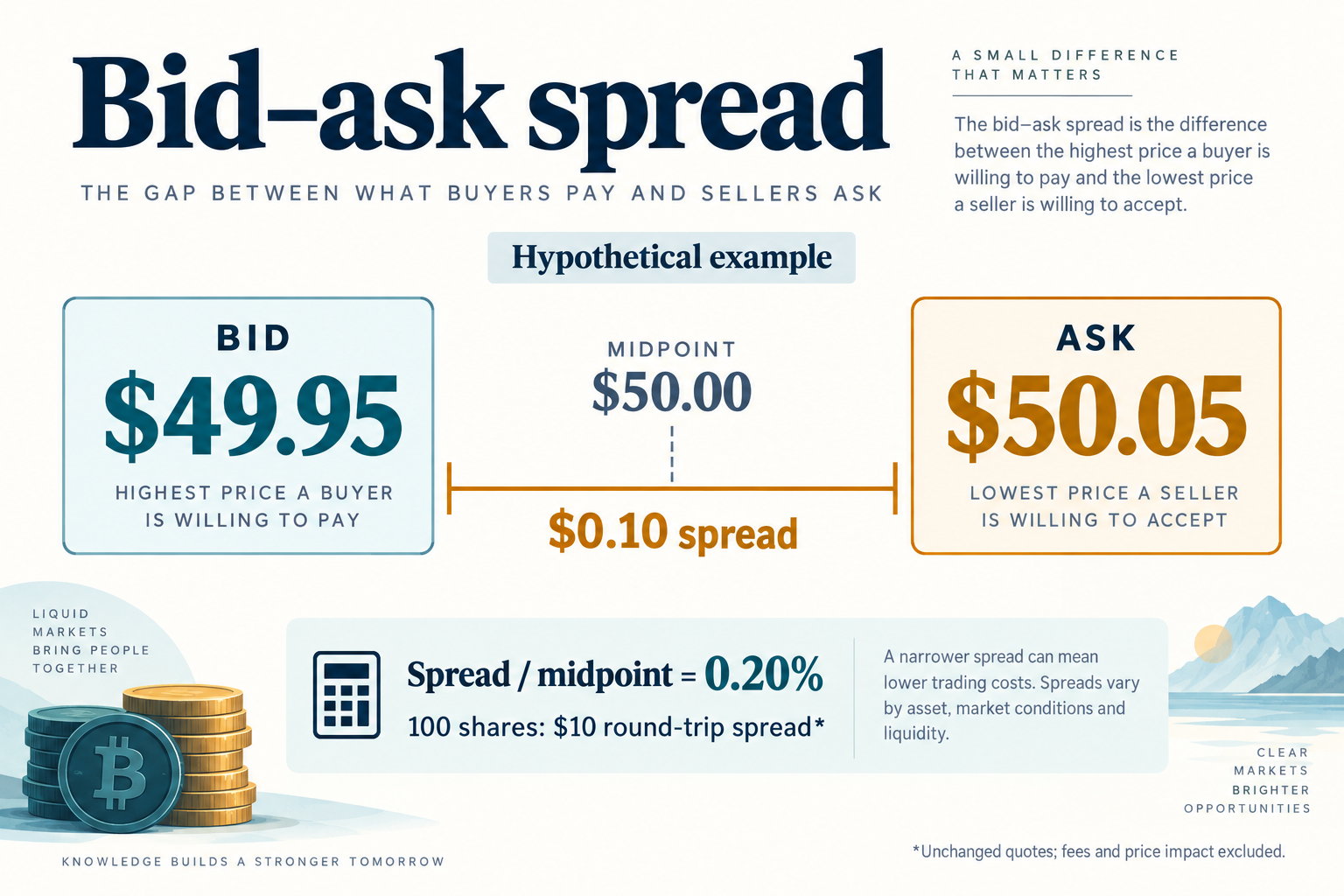
The 0.20% in this example is the full quote spread divided by the midpoint; it is not a separate fee rate necessarily charged on each purchase. In this symmetrical example, the difference in each direction relative to the midpoint is 0.10%. Actual orders may differ from the example because of quote changes, available size, partial fills, and price impact. A limit order does not guarantee execution at the desired price.
A median spread reported by an issuer for a past period should not be assumed to match the quotes for a current order. First compare the current best bid and ask with the available size for your order quantity.
Do not add the premium/discount, annual expense ratio, and funding fees as if they were the same cost
| Item | What to distinguish | Reference materials |
|---|---|---|
| Premium/discount | A comparison between market price and NAV. It is not a fee charged separately by the exchange. | The issuer’s published NAV and methodology for reporting premiums and discounts |
| Annual expense ratio and product costs | Costs reflected in the product’s assets and tracking performance. Check separately for any waiver or change conditions. | Latest prospectus and expense disclosures |
| Brokerage, currency conversion, and taxes | Separate conditions based on the individual’s account, place of residence, and trading method | Official guidance from the brokerage and relevant authorities |
| Quotes and price impact | Trading conditions that affect the execution price | Current quotes, available size, and trade history |
| Perpetual futures funding fees | A separate settlement mechanism for derivatives positions. These are not the same as the expenses of shares in a spot trust. | Settlement rules for the relevant derivative |
If you have confused an ETF premium or discount with the funding rate on Bitcoin perpetual futures, review the difference between funding rate calculations and trading fees separately. Costs for different products have different scopes, time periods, and denominators, so do not mechanically add them just because they are expressed as percentages.
Five steps to check before assessing a premium or discount
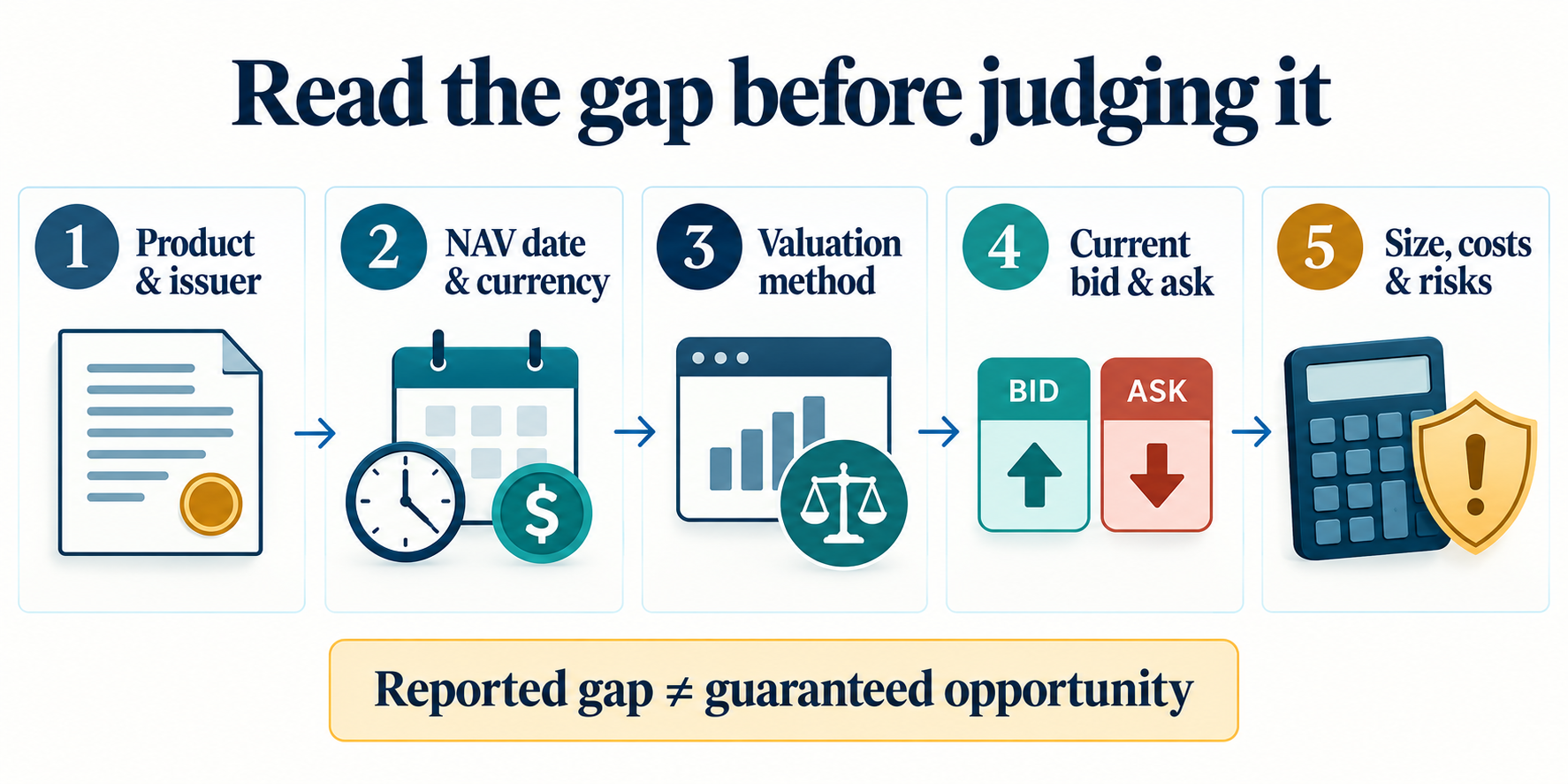
- Confirm the product and issuer. Check the exact ticker, legal structure, underlying asset, and exchange. Do not confuse it with similarly named futures-based or leveraged products.
- Check the NAV date, time, and currency. Determine whether the displayed value is based on the previous day and whether it is in the same currency as the price you are comparing it with. If the quote is delayed, do not treat it as current.
- Check the valuation method. Determine whether it is a price at a specific point in time or an average over a period, and read the basis stated in the official materials. Do not apply another product’s valuation rules instead.
- Check current quotes and available quantities. Do not treat the closing price, last traded price, or historical median spread as the price currently available for trading.
- Check order size, total costs, and risks. Distinguish brokerage and currency-conversion costs, trading hours, price volatility, trading halts, and liquidity risks. Check eligibility and whether your broker permits trading based on your own account.
If the findings are unclear: Do not assume the cause when you lack information to distinguish a timing mismatch from an actual price difference. First check the issuer’s latest disclosures, the product’s prospectus, and your broker’s official trading guidance. Individual investors should not assume they can use the same creation and redemption terms as authorized participants (APs). Even when creations, redemptions, and arbitrage can help align prices, they do not guarantee that a premium or discount will be eliminated.
Frequently asked questions
Does a negative premium or discount mean I can buy at a bargain?
It means the market price is below the NAV calculated on the stated basis. First check whether that NAV reflects the current value of the assets at the same point in time, as well as the applicable trading costs and restrictions. A low price does not eliminate the possibility of loss or guarantee a profit from the premium or discount closing.
Can I directly compare NAV with the Bitcoin price?
You must first align the units. NAV per ETF share and the price of one BTC are different units. A simple numerical comparison is meaningless unless you check the asset exposure and valuation basis per share.
If iNAV is available, can I use it instead of daily NAV?
If an intraday indicative valuation is available, check its update time, calculation method, and any data delays. You cannot assume that every product has the same intraday indicator, nor does an indicative value mean it is the same as the official daily NAV or the actual execution price.
If I add a 0.20% spread to the annual expense ratio, is that the total cost?
Adding them as-is may mix different time periods and bases. The 0.20% above is the percentage of an assumed bid-ask spread, while the annual expense ratio is a product cost measured over a different period. Calculate them separately, accounting for the holding period, number of orders, actual execution prices, and account costs.
What happens to the ETF price on Monday if Bitcoin moves over the weekend?
The underlying asset trades continuously, while securities markets have periods when they are closed, so the ETF may trade at a different price when the market reopens than at its previous close. The direction and magnitude cannot be determined with certainty, and you should not confuse the previous day’s NAV or closing price with the current quote.
Official sources, scope of verification, and risk disclosure
- iShares: All about ETPs: Premiums and discounts — Published 2026-09-10. Examples of IBIT valuation timing and interpreting reported premiums and discounts.
- Investor.gov: Exchange-Traded Products (ETPs) — Legal classifications of ETPs, ETFs, and commodity trusts.
- SEC: Updated Investor Bulletin: Exchange-Traded Funds (ETFs) — Published 2023-02-23. General concepts of NAV, market prices, and bid-ask spreads. Legal scope applies to registered ETFs.
Written and reviewed by: CoinPop / Hyun Lee. The official sources above were checked on 2026-10-09. The calculations, comparison table, and images are educational explanations by CoinPop and are not based on direct trading results or produced by an official institution. Real-time premiums and discounts, the creation and redemption rules for all products, current purchase eligibility at Korean brokerages, and individual tax circumstances are outside the scope of verification. Product terms and policies may change.
This article contains no direct sign-up CTA or affiliate links to ETFs or exchanges. Other linked CoinPop documents may contain affiliate links, through which CoinPop may receive compensation. Bitcoin and related products carry risks of principal loss, sharp price fluctuations, custody and operational issues, and illiquidity. This article is not investment advice and does not replace any individual’s buy or sell decision.

