

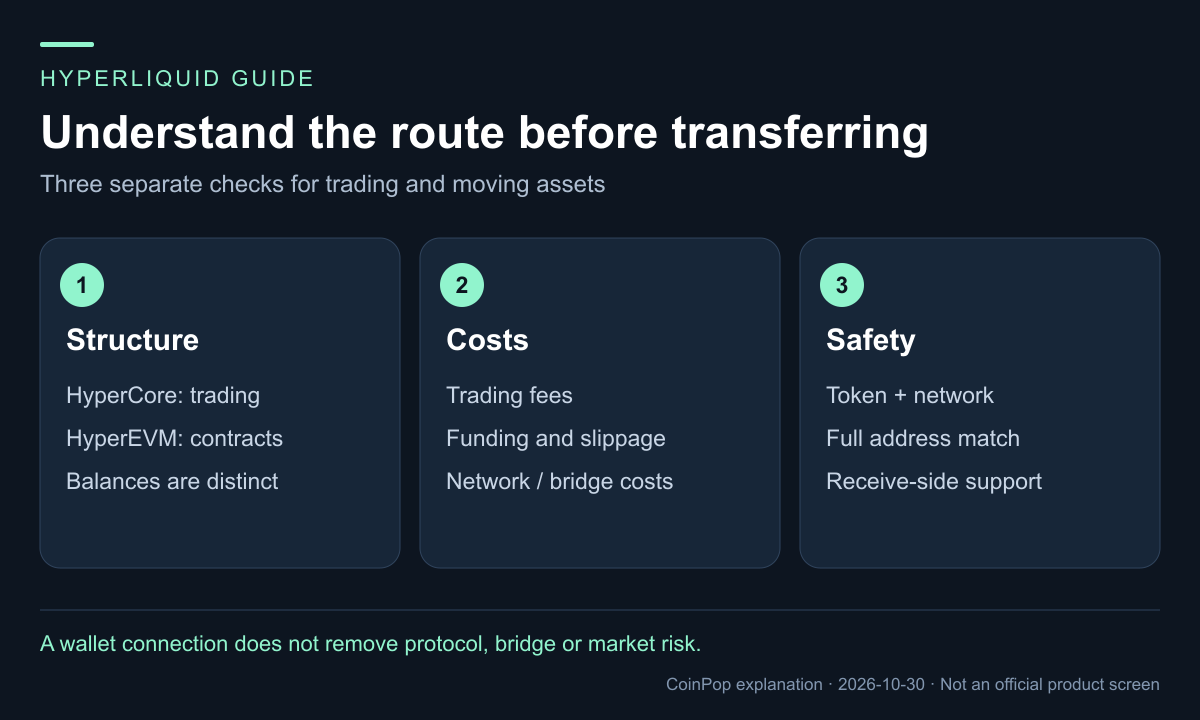
Hyperliquid is an on-chain order book platform for trading spot and perpetual futures on its own blockchain. Before using it, distinguish where assets are held in HyperCore and HyperEVM, trading and transfer costs, and whether the receiving exchange supports the network. From explaining the structure to deposits, balance checks, orders, and withdrawals, this article outlines what to verify on the actual screens.
Verified on: October 30, 2026. Corrections were made based on official documentation and publicly available terms of use. Fees, supported assets, and terms of use may change, so check the displayed values again immediately before proceeding. The diagram below is explanatory material from Coinpop and is not an actual trading screen.
What Is Hyperliquid?
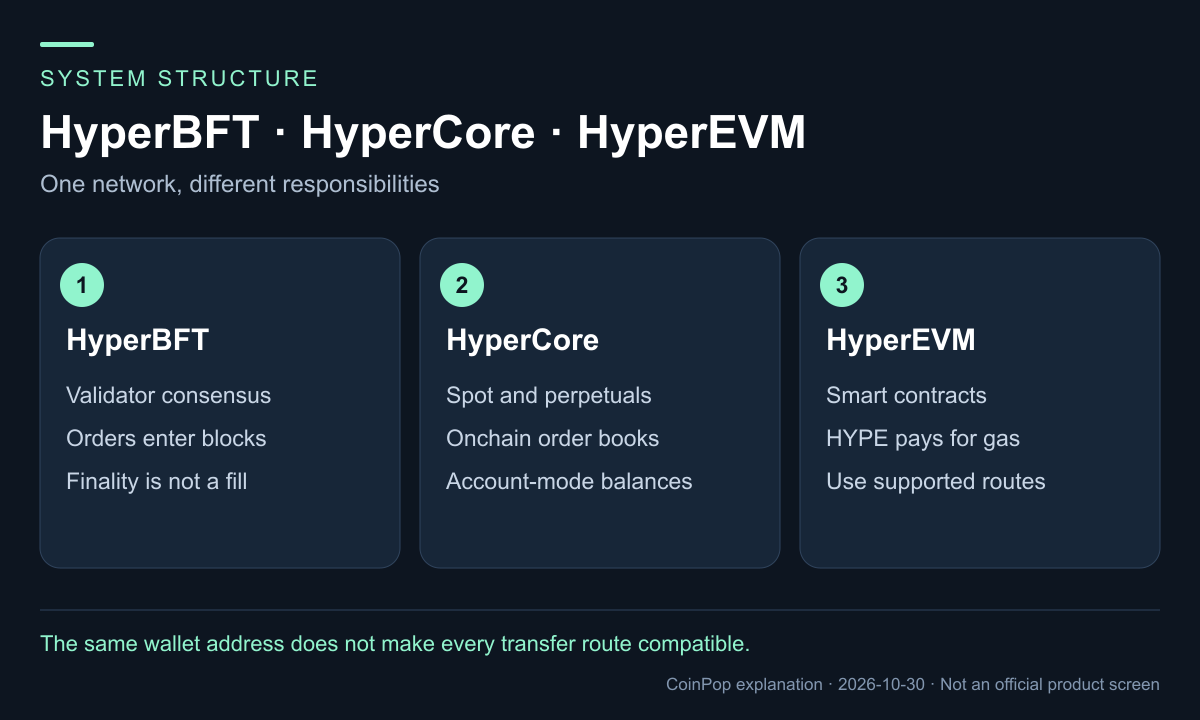
Hyperliquid has HyperCore, which handles trading functions, and HyperEVM, a smart contract execution environment, within a single L1 network. Spot trading and perpetual futures have different product structures. For example, holding a long position in BTC perpetual futures does not mean you own withdrawable spot Bitcoin. Distinguish product names and settlement assets based on the official structural explanation.
The official introduction describes Hyperliquid Labs as a core contributor led by Jeff and iliensinc. Labs says it operates using its own funds, but this does not eliminate the risk of future token supply increases or market losses. Review the core contributor information separately from current circulating supply and unlock schedules.
Criteria to Use When Reviewing Statistics
- Compare trading volumes only across data that use the same time period and spot or derivatives scope. Cumulative volume and monthly volume are not the same metric.
- Market share varies depending on the exchanges being compared and the time of data aggregation. This article does not present “50% market share, No. 1 worldwide” as a current fact without a verification date.
- Do not assess liquidity based only on total trading volume. Check the bid-ask spread for the asset you plan to trade and the expected execution price for your order size.
How Is It Different from Other DEXs?
HyperCore uses an on-chain order book containing limit orders. Orders are submitted and canceled, and trade results are checked. However, the fact that activity is recorded on-chain does not guarantee that an order will execute at the desired price or reduce losses. Shallow order book depth or sudden price movements can result in slippage or unfilled orders.
Gas Fees and Trading Fees Are Different
Do not treat standard HyperCore order submission as equivalent to an Ethereum smart contract call. Conversely, do not assume that “everything is free after paying once.” Check trading fees and funding, costs along deposit and withdrawal routes, and HYPE gas fees on HyperEVM separately. According to official documentation, the first incoming transaction for a new HyperCore account incurs an activation fee of one unit of the quote asset (e.g., 1 USDC or 1 USDT). Verified on October 30, 2026; check the account activation fee information and any deduction shown on the deposit screen.
Wallet Connection, Email Login, and Eligibility
The official getting-started guide offers email login in addition to connecting an existing wallet. Using a wallet connection does not mean the service is available without restrictions in every country. The official terms of use specify restrictions covering the United States, Ontario, Canada, and sanctioned parties, among others, and impose additional restrictions for certain products. Check the terms and applicable laws where you reside, and do not circumvent access restrictions if access is blocked.
Technical Structure – HyperCore, HyperEVM, and HyperBFT
HyperBFT: Distinguishing Block Finality from Order Execution
HyperBFT handles validator consensus. A claim that blocks are finalized quickly does not mean every order executes within one second. Execution requires a counterparty order, a specified price, liquidity, and order conditions. Do not interpret performance figures as guarantees of profit or execution.
HyperCore: Order Books and Account Modes
HyperCore processes spot and perpetual futures order books, among other things. Current official documentation distinguishes Unified, Portfolio margin, and Manual/Standard modes. Unified combines spot and related futures balances in the same asset, while Manual/Standard keeps spot, futures, and DEX-specific balances separate. Therefore, the statement “USDC is always deposited to the futures wallet” does not apply to all accounts. Check the account mode information to see the scope of collateral use as well.
HyperEVM: The Same Address Does Not Mean the Same Balance Location
HyperEVM is a smart contract environment, and HYPE is the gas asset. Even if you use the same wallet address, do not confuse HyperCore and HyperEVM balances. Check supported routes such as “Transfer to/from EVM” in the official Portfolio. Avoid arbitrary transfers, such as sending other tokens to the system address for HYPE. Separately check the receiving exchange's deposit screen to see whether it supports only HyperCore or HyperEVM as well. See the HyperEVM usage guide.
HYPE Token: Utility and Supply Risks
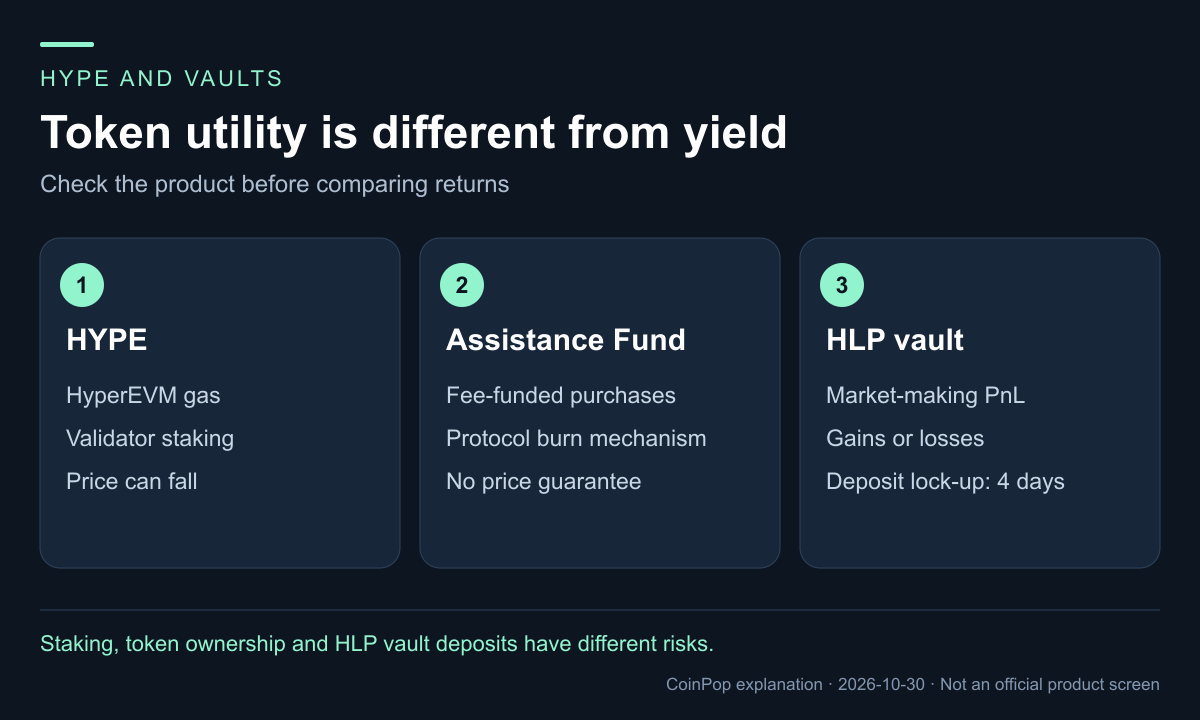
HYPE is an asset used for network staking and HyperEVM gas, among other things. Holding the token, delegating it to a validator, and depositing USDC or other assets into HLP are distinct choices. Comparing them all as the same kind of “yield” can make it easy to overlook changes in principal value and withdrawal terms.
What to Check About Staking
Staking rewards are not fixed deposit interest. They vary based on validator fees and overall staking conditions, among other factors, and declines in the price of HYPE must also be considered separately. According to official documentation as of October 30, 2026, delegating to a validator involves a 1-day lock, while transferring staked balances to spot involves a 7-day queue. Check the official staking terms and the unlock time currently shown on screen.
Assistance Fund: Buybacks and Burns Do Not Guarantee Price
Official fee documentation explains that fees are allocated to HLP, the Assistance Fund, deployers, and others, and that the Assistance Fund automatically purchases HYPE, which is then burned. This should not be interpreted as a price floor or guarantee of appreciation. Circulating supply, future distributions, and market selling demand all affect the price. Do not substitute historical distribution ratios for today's circulating supply ratio or the amount unlocked each day.
Fee Structure: Base Rates and Actual Costs
The official base Tier 0 rates as of October 30, 2026 are shown below. These are rates before staking and trading-volume discounts and do not guarantee the same final rate across all markets. Source: official Fees documentation.
| Product | Maker | Taker |
|---|---|---|
| Perpetual futures base rate | 0.015% | 0.045% |
| Spot base rate | 0.040% | 0.070% |
Volume tiers are determined based on recent 14-day performance, among other factors. Final costs may vary based on staking discounts, the quote asset, HIP-3 deployer settings, and additional fees from external interfaces, so check your account and market rates before placing an order. Funding, slippage, and transfer costs are separate from trading fees.
Maker/Taker and Referral Terms
A limit order can still be a taker order if it immediately matches an existing order. Post Only is a condition that places an order in the order book, so check it along with whether the order executes. The order type guide explains each condition.
The discount in the official referral documentation is a 4% discount on trading fees for the first $25 million in trading volume; it is not a permanent discount. It does not apply to vaults or subaccounts. It also does not mean a reduction of 4 percentage points. Terms verified on October 30, 2026. Check the official referral terms and whether they apply to your account.
How to Use It – Deposit, Check Balances, Place Your First Order, and Withdraw
Step 1: Verify the Official Address and Connection Method
Verify the address of the official app, then select a supported wallet or email login under Connect. After connecting your wallet, read the signature details under Enable Trading. Never send your seed phrase or private key to a website or customer support. No actual wallet connection, signing, or transfer was performed here.
Step 2: Select the Asset and Network for Deposit
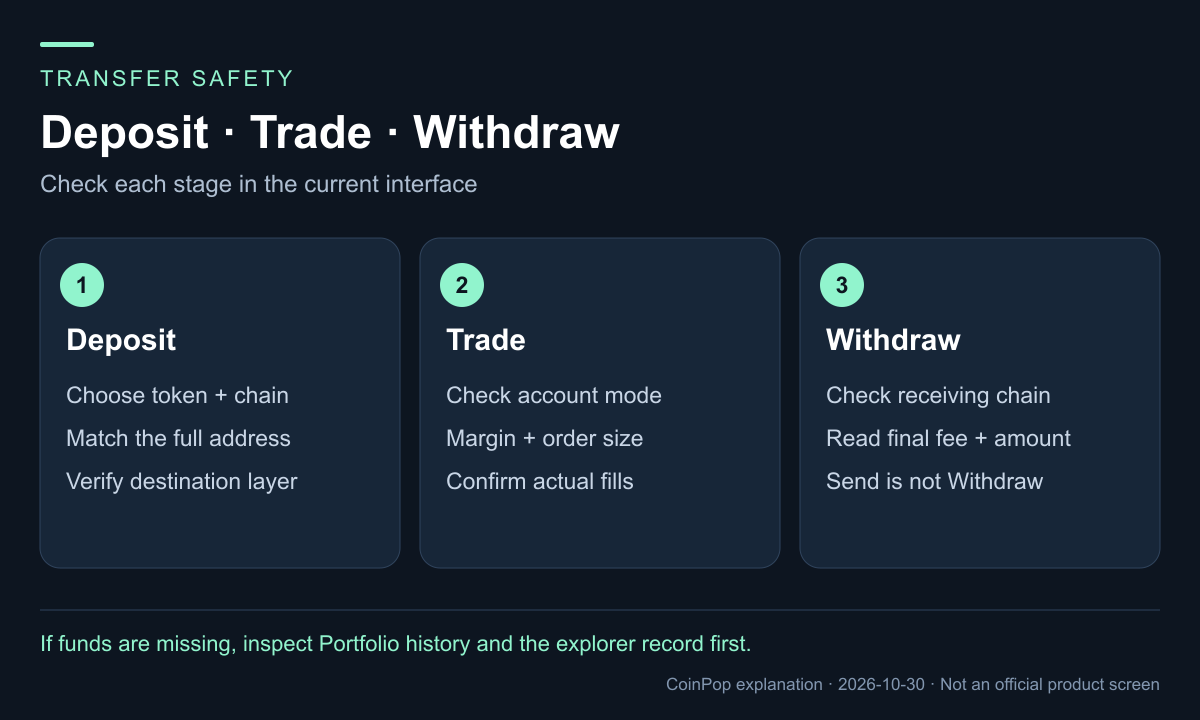
In Deposit, check the currently supported tokens, source chains, and destination areas. Do not assume that Arbitrum USDC is the only deposit route. Check on screen the source-chain gas asset needed for the selected route, the minimum deposit amount, and the estimated amount to be received, and verify the entire address. Supported routes may change. Check the current options based on the official getting-started guide.
Step 3: If the Deposit Arrived but the Futures Balance Is Not Visible
- Check the deposit and withdrawal history in Portfolio and the explorer to verify the actual destination chain and asset. An exchange's withdrawal-completed status is separate from confirming that the funds are available for trading on HyperCore.
- Check whether you are on HyperCore or HyperEVM, and which account mode you are using, such as Unified or Manual/Standard.
- In split mode, check the spot and futures balances or the relevant DEX’s collateral balance and transfer menu. In unified mode, review available collateral, existing orders, and amounts committed to positions.
- If a balance is not visible, do not repeatedly deposit the same amount. First verify the route using the TxID and official support guidance.
Step 4: Check Orders and Fills
Determine whether the instrument you are trading is spot or a perpetual future, and check the collateral asset, cross/isolated margin, order value and quantity, and leverage. Choose a market or limit order and read the stop-loss conditions. After submitting, do not stop at confirming that the order was received; check the actual filled quantity, average price, and any remaining order. When closing, check the position and any remaining orders separately as well.
Liquidation occurs when account assets fall below the maintenance margin requirement, and the mark price may differ from the last traded price. With cross margin, other positions and collateral may also be affected. Stop-loss orders do not guarantee execution at the expected price in volatile markets. See the official explanation of liquidation.
Step 5: Check the Withdrawal Route from the Recipient’s Perspective
In Withdraw, select the asset, chain, and destination address actually supported by the recipient, then review the final fee, minimum amount, and estimated amount to be received. Withdrawal times and fees cannot be stated as “always a few minutes” or “free.” When sending to a domestic exchange, separately check that exchange’s wallet and network support, sender verification, and Travel Rule guidance.
Send and Withdraw are different. According to the official support documentation, Send transfers funds to another account on the Hyperliquid chain. Do not use Send as a substitute for withdrawing to another chain or exchange. If funds do not arrive, check the operation type and status under Deposits & Withdrawals in Portfolio, then compare the recipient address using the explorer link in the completed transaction record. See the steps for checking a missing withdrawal.
Vaults and HLP: Risks Unlike Those of Deposits
HLP (Hyperliquidity Provider) is a protocol vault that generates profits and losses through market making, liquidations, and supplying USDC to Earn, among other activities, while accumulating a portion of trading fees. Participants share both profits and losses. It must not be presented as a deposit that guarantees principal or a fixed APY.
As of the official HLP documentation dated October 30, 2026, a four-day lock applies after the last deposit. Additional deposits affect when withdrawals become available, so check the current unlock time. Do not assume that other vaults have the same terms; check each one’s operator, strategy, profit and loss, fees, and lock-up conditions.
Risks: First Check Where Your Assets Are and How You Could Lose Them
- Market and liquidation risk: Leverage, slippage, and funding can result in losses, and you could lose all your collateral.
- Protocol, validator, and oracle risk: On-chain records do not guarantee that code, price inputs, consensus, or operational decisions are always safe.
- Bridge and network risk: Even if wallet addresses are the same, sending funds to the wrong chain or domain may make recovery difficult or impossible.
- Wallet and signing risk: Beware of fake domains, malicious approvals, and people impersonating support. Never share your private key or seed phrase.
- Terms of use and withdrawal risk: Access availability is separate from lawful use and support by the receiving exchange. Check for service delays and lock-up conditions as well.
The cause, amount of loss, and recovery status of any specific incident must be checked separately against official records from the time of the incident. This article does not assess safety based on incident-loss figures without sources and dates or on claims that “everything was fully recovered after the incident.”
Hyperliquid vs. Centralized Exchanges: A Like-for-Like Comparison
| Category | Hyperliquid | Centralized exchange |
|---|---|---|
| Assets and control | Use the protocol by signing with a wallet; protocol and bridge risks remain after depositing | Check exchange-account custody and operational and withdrawal risks |
| Terms of use | Check regional and product restrictions on the official interface | Check each exchange’s identity verification, regional, and product requirements |
| Trading costs | Compare costs by instrument, account tier, gas, funding, and route | Compare costs by instrument, account tier, withdrawal, and funding |
| Transparency | On-chain records, including orders and trades, can be checked | Separately check the scope of public disclosures and explanations of reserves and liabilities |
| Deposits and withdrawals | Distinguish between HyperCore, HyperEVM, and external chains | Check supported chains, minimum amounts, confirmation counts, and review requirements |
| Liquidity and liquidation | Check the order book, collateral, and mark price for the relevant instrument | Check the order book, collateral, and mark price for the relevant instrument |
When comparing, rather than concluding that “DEXs are always safe” or “always cheaper than CEXs,” compare the actual terms for the instrument and amount you plan to trade and the asset transfer route. The following guides may contain affiliate links, and CoinPop may receive a commission when a user completes an activity that meets the reward conditions. Check the terms in each guide and on the final application screen for details of any benefits.
Frequently Asked Questions
Q1. Can I use Hyperliquid in any country without KYC?
The way you connect a wallet and your eligibility to use the service are separate matters. The official interface has restrictions relating to the United States, Ontario in Canada, and sanctions, among others, and conditions also vary by product. Check the terms of use and applicable laws; we cannot advise you on ways to bypass access restrictions.
Q2. Are all Hyperliquid fees and gas costs free?
No. Check the base trading rates and the costs associated with account activation and transfer routes. HyperEVM requires HYPE for gas fees. The final rate depends on the trading product, tier, discounts, and any additional costs.
Q3. Why can’t I see my futures balance after depositing?
Check the destination on HyperCore or HyperEVM, account mode, spot and futures collateral, and available balance in that order. Balance structures differ between Unified and Manual/Standard. First check your deposit and withdrawal history and TxID; do not rush to deposit again.
Q4. Can I withdraw to a domestic exchange using Send?
Send is for transfers within the Hyperliquid chain; it is not a withdrawal function for sending to another chain. Check which assets and networks the receiving exchange supports and use a supported Withdraw route. Verify the full address and final amount to be received.
Q5. Are HLP and HYPE staking the same product?
No. HLP is a vault that shares profits and losses from activities such as market making, while HYPE staking involves delegation to a validator. Their reward structures, principal price risks, lock-ups, and withdrawal waiting periods differ.
Q6. If I buy BTC futures on Hyperliquid, can I withdraw bitcoin?
A perpetual futures position is different from holding spot bitcoin. To use BTC-related spot or transfer features, separately check the asset structure of the relevant product and its supported withdrawal routes.
Final Checks Before Use
- Have you checked the official domain, eligibility, and product type?
- Have you distinguished the destination domain, account mode, collateral, and order amount?
- Have you calculated funding, slippage, and transfer costs in addition to trading fees?
- Have you checked the recipient’s network support, the full address, and the actual amount to be received?
- Do you understand the lock-up and loss risks of HLP and staking?
To compare terms across exchanges, see the CoinPop exchange comparison guide. Before trading, it is best to first check whether you can explain where your assets are and what costs and potential loss paths apply.
Official Sources and Scope of Corrections
Checked on: October 30, 2026. We reviewed Hyperliquid’s documentation on its structure, fees, referrals, account modes, HyperEVM, activation costs, liquidations, HLP, and staking, as well as its official terms of use, which are linked in the article. We corrected statements about market share and trading volume without dates, outdated base rates, claims of permanent discounts, confusion over token allocation, and guarantees about execution times. This article is a review of public documentation; it does not report results from signing up for an account, connecting a wallet, trading, or making transfers.
This article is for informational purposes only and is not investment advice. Using cryptocurrency, derivatives, and DeFi involves risks, including the loss of all principal. Separately check applicable laws and consult a professional regarding your eligibility to use these services and any tax or reporting obligations.

