

CARF is an international standard for collecting and reporting crypto-asset transaction information and exchanging it among tax authorities. It does not mean that all countries will exchange information simultaneously in 2026 or audit every investor. This article separately explains what records users of overseas exchanges should prepare and what reporting requirements businesses should verify.
The key questions are who reports to which country, what information is aggregated, and when collection, submission, and exchange take place. Actual obligations and tax treatment must be determined in accordance with the laws and guidance of the relevant country. Official sources checked on: October 28, 2026.
1. What Is OECD CARF? The Difference Between Reporting Frameworks and Tax Determinations
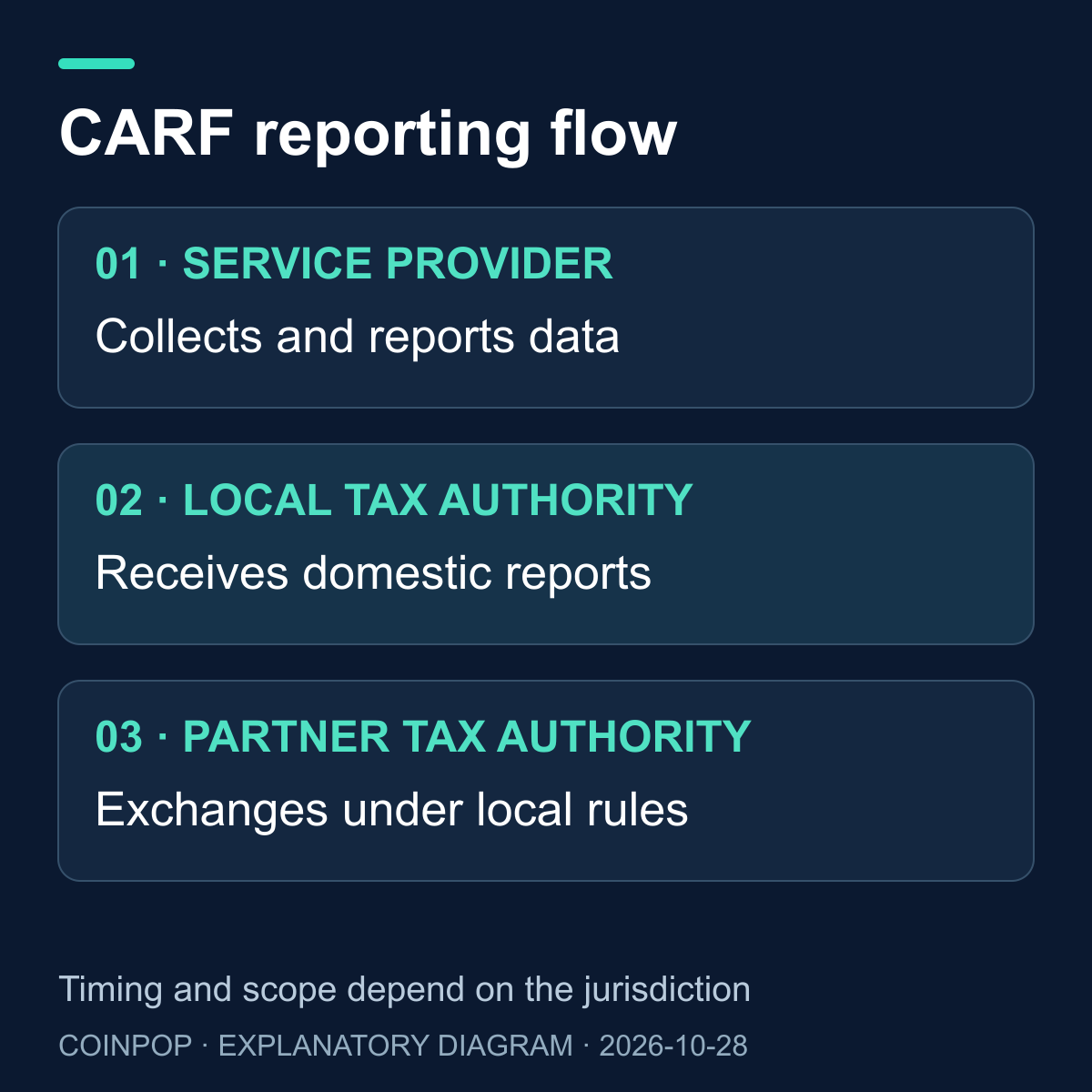
The Crypto-Asset Reporting Framework (CARF) is a crypto-asset reporting framework developed by the OECD. The general flow is reporting crypto-asset service provider (RCASP) → domestic tax authority → tax authority of a partner jurisdiction. It should not be understood as a system in which providers send the same file directly to tax authorities worldwide.
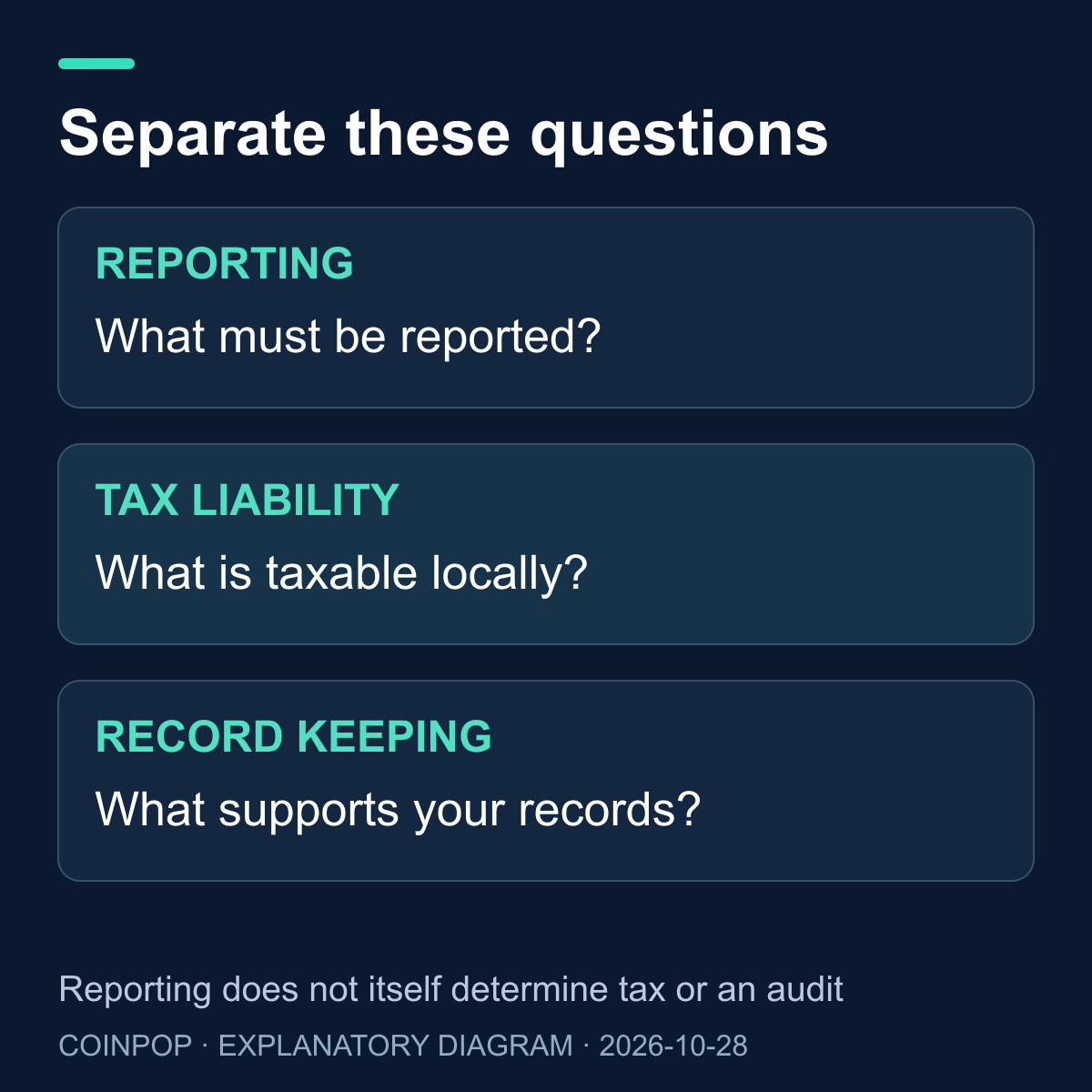
A country's indication that it intends to participate in the OECD framework or its signature of a multilateral agreement does not, by itself, mean that exchanges have already begun between all countries. Domestic legislation taking effect, specific reporting obligations being established, and exchange relationships being activated must also be checked. CARF reporting obligations, individuals' income tax filing obligations, and selection for a tax audit are separate matters.
CARF should also be distinguished from CRS, the existing standard for reporting financial accounts. CARF covers relevant crypto-asset transactions, but not every wallet, NFT, or decentralized service automatically becomes reportable based on its name alone. The nature of the asset, the provider's functions, and the implementing rules of the reporting jurisdiction must all be considered.
2. Who Reports What, and Where?
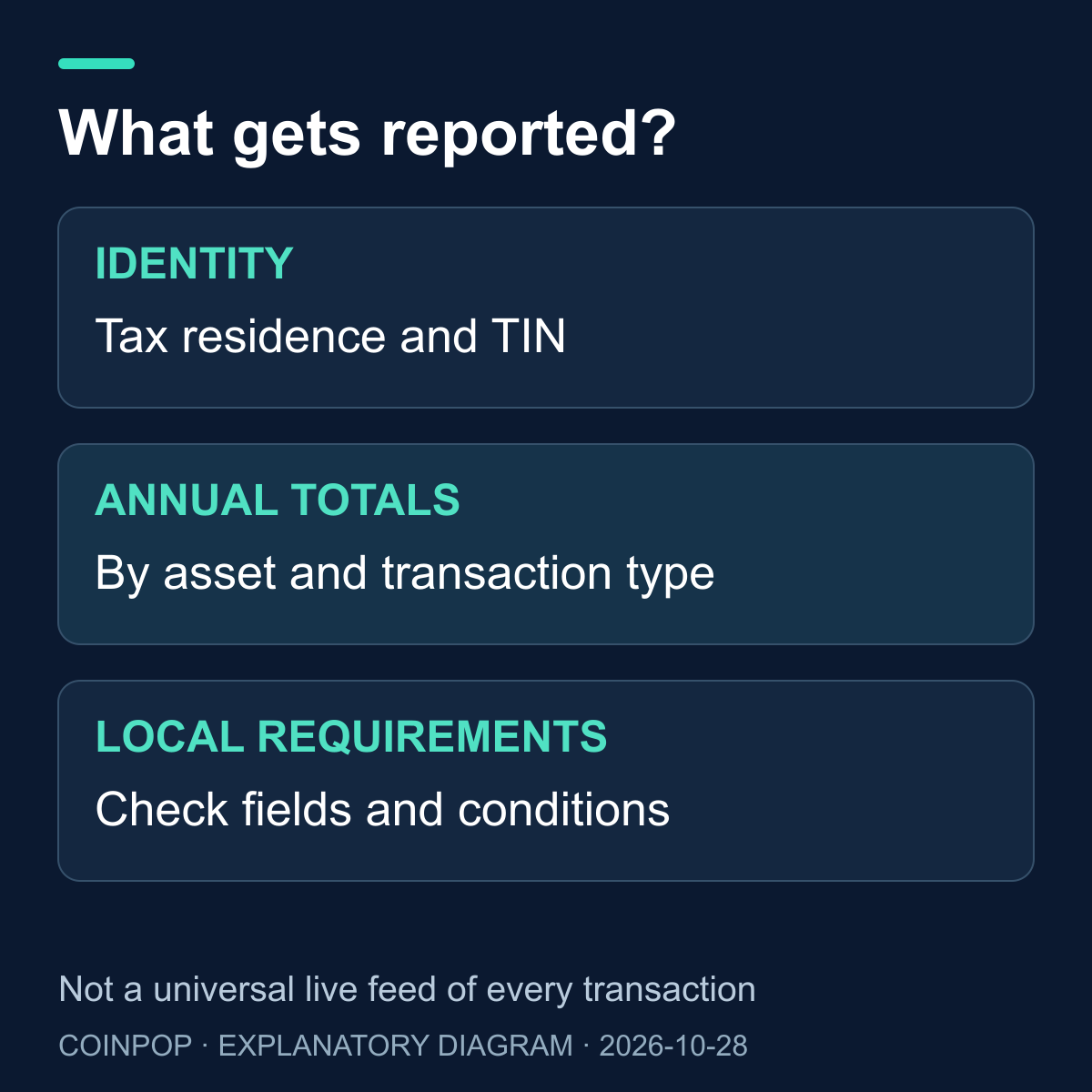
Businesses must first determine whether they are reporting providers and identify their reporting jurisdictions. Individual users should verify the accuracy of the tax-residence self-certification, taxpayer identification number (TIN), and identity information requested by an exchange, and report any changes through the prescribed process. The fact that an exchange offers services in Korean does not, by itself, establish that Korea is its reporting jurisdiction.
- User information: Applicable identifying information, such as name, address, tax residence, and TIN. For entity users, also check the conditions under which information about controlling persons is required.
- Transaction information: The focus is on annual aggregates by asset and transaction type. Depending on the type, fields such as amount, number of units, and transaction count are distinguished.
- Transfer information: Reporting items and conditions for relevant transfers must be checked. It cannot be assumed that every wallet address and TXID an individual keeps as supporting evidence will appear as is in every country's XML.
Therefore, it is inaccurate to describe CARF as a system that relays every individual transaction and an entire lifetime of transaction history in real time. However, annual aggregate reporting does not make individual transaction records unnecessary. Providers must maintain source records supporting their aggregates and enabling error correction, and respond to separate requests for information from authorities in accordance with applicable law.
The distinctions above are based on the OECD CARF XML Schema User Guide (July 2025). Check jurisdiction-specific guidance for domestic submission fields and exceptions.
3. Does It Take Effect in 2026? Distinguish Schedules by Country
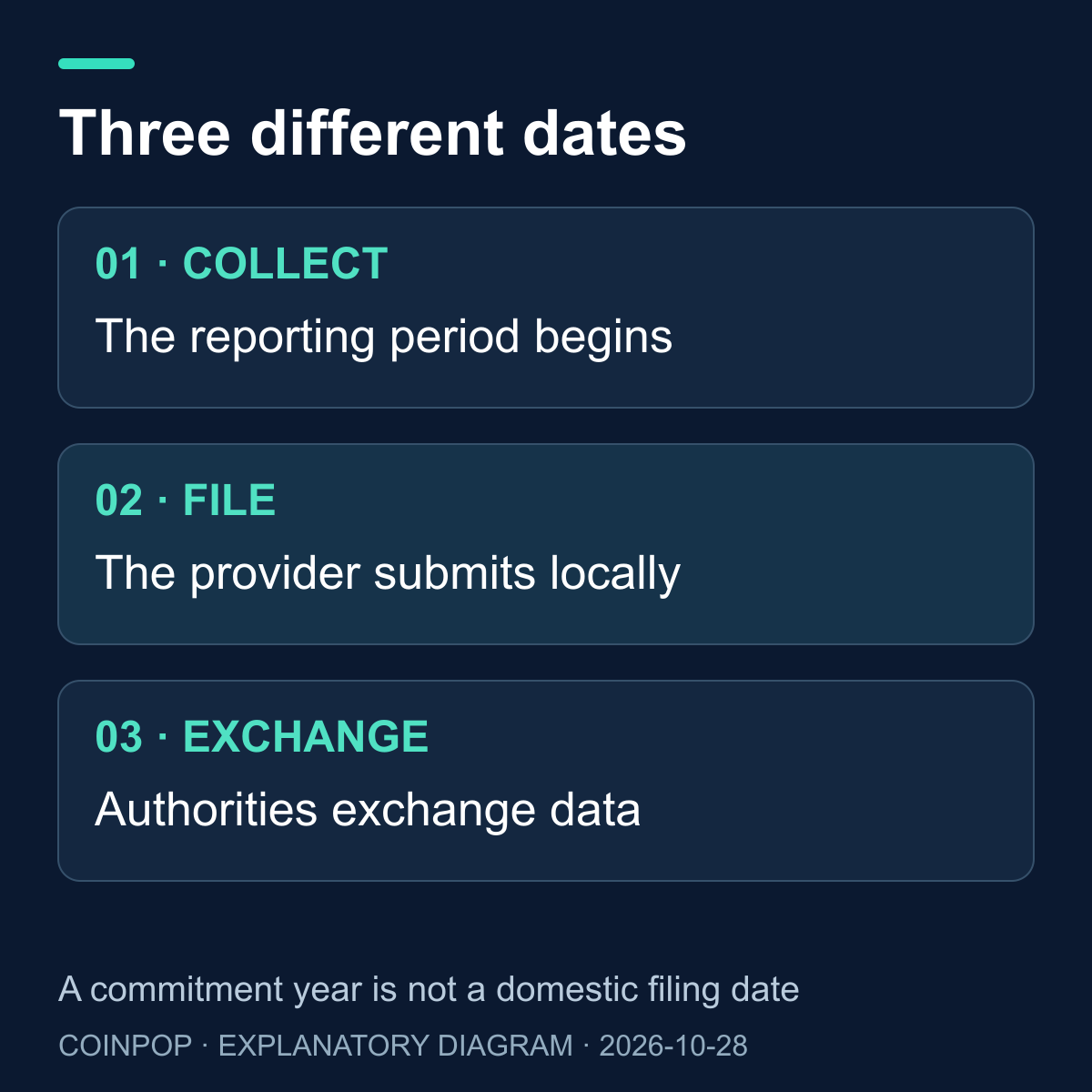
The information collection period, the provider's domestic reporting deadline, and the first international exchange between tax authorities are separate dates. The examples below are official cases that have been verified; they are not a single implementation schedule for the entire world. They do not guarantee subsequent changes to a country's implementation or whether a particular provider is covered.
| Jurisdiction | Verified schedule and interpretation |
|---|---|
| United Kingdom | Takes effect on January 1, 2026. The first reporting period is January 1–December 31, 2026, and the first domestic reporting deadline for that period is May 31, 2027. Official HMRC guidance |
| EU · DAC8 | Collection of relevant information begins on January 1, 2026. The first exchange of 2026 information between tax authorities of member states is due by September 30, 2027. This does not mean that September 30 is the domestic filing deadline for all providers; member-state rules must be checked. European Commission DAC8 guidance |
| United Arab Emirates | Domestic implementation is scheduled for January 1, 2027, and the first international exchange for the 2027 reporting period is indicated as taking place in 2028. UAE Ministry of Finance guidance |
| Korea | The OECD list updated on September 14, 2026, includes Korea among the jurisdictions that have committed to conducting their first exchange by 2027. This commitment year alone does not establish the domestic collection start date or provider filing deadline. This article does not assert a separate domestic deadline. Check the OECD list of commitments by country alongside the latest implementation guidance from domestic authorities. |
4. How Should a Company's CARF XML Reporting System Be Set Up?
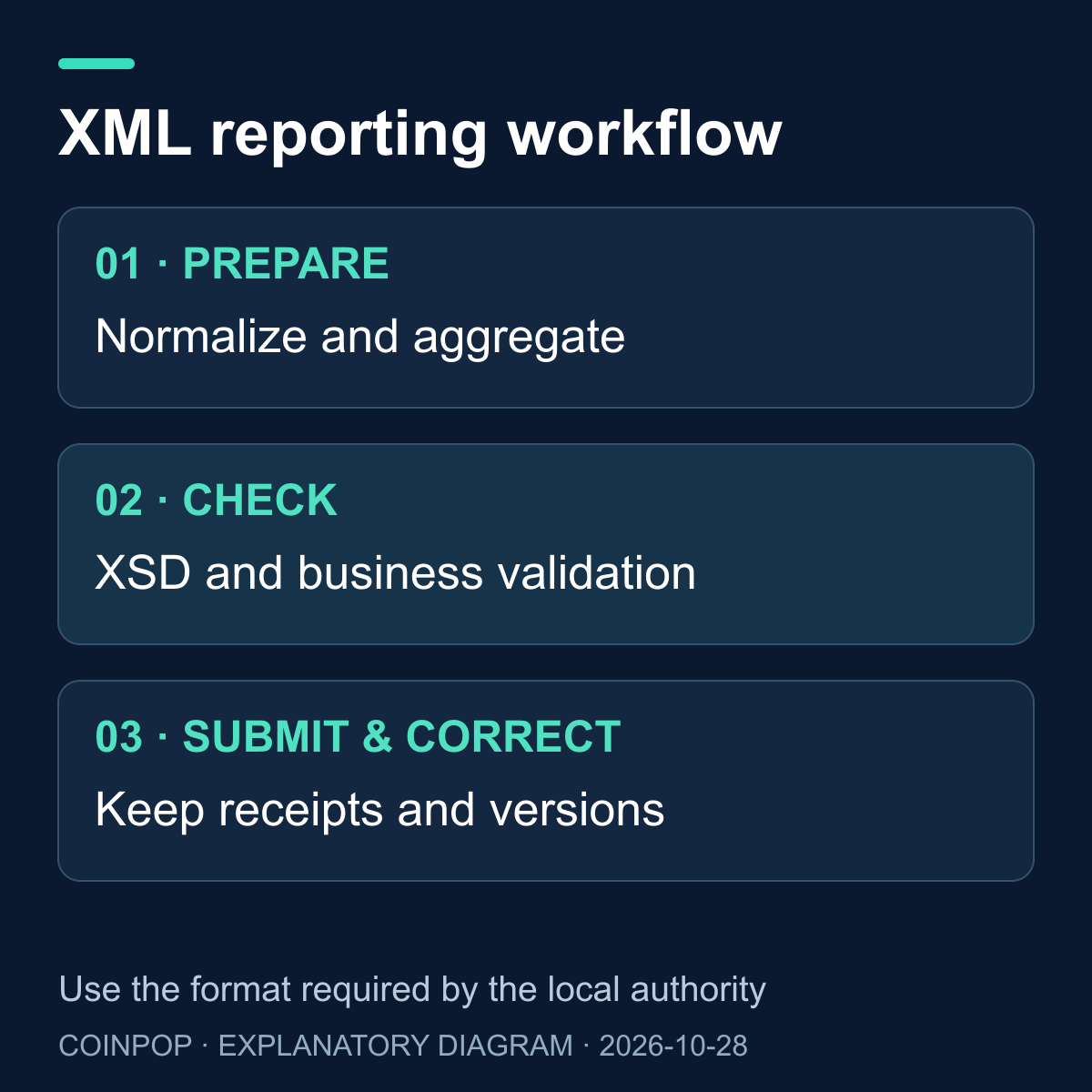
The starting point is not to equate the OECD's schema for exchanges between authorities with an exchange's domestic submission format. The OECD XML guide is primarily for exchanges between tax authorities; domestic reporting must follow what the relevant jurisdiction permits or requires. The versions verified in the OECD repository are CARF XML Schema 1.5 / User Guide 2.0 (July 2025). The schema and guide have different version numbers, and for actual submissions, the file format, version, and business rules specified by the relevant authority take precedence.
- Collection and normalization: Maintain required source data in a consistent format, including user and entity identifiers, tax residence and TIN, transaction timestamps, assets, quantities, amounts, and fees. Design access controls and retention requirements for personal information as well.
- Classification and aggregation: Classify reportable assets and transaction types according to jurisdictional rules, and record the conversion method, reporting period, and basis for annual aggregates. Linking internal TXIDs to ledger entries is a recordkeeping measure for reconciliation, not a common mandatory field in every XML.
- Format and business validation: First validate the structure and data types using the applicable XSD, then perform separate business checks for required values, identifiers, permitted codes, reporting periods, duplicates, and numerical consistency. Passing XSD validation alone does not guarantee acceptance or legal compliance.
- Submission and receipt: Use the portal, transmission method, and authentication process designated by the domestic authority. Not every provider must connect directly to the OECD's international exchange network.
- Corrections and tracking: Retain the submitted file version, receipt result, error messages, links between corrections and cancellations, and resubmission history. Also distinguish the role of domestic feedback formats from that of the OECD Status Message schema.
Official files are available from the OECD tax transparency repository. Using a particular cloud product, accounting solution, or certification mark does not, by itself, guarantee CARF compliance.
5. Checklist for Businesses Operating in Multiple Countries
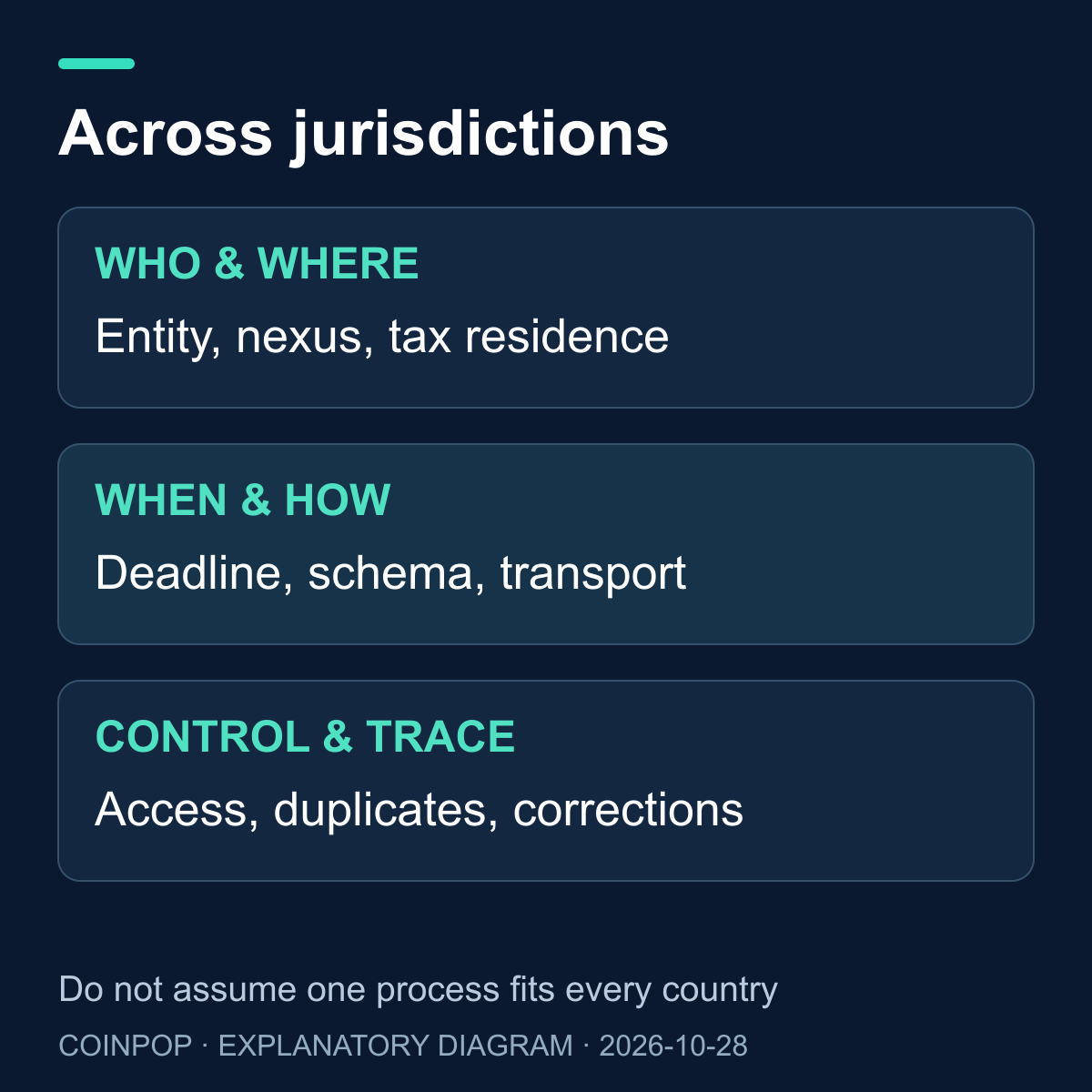
The challenge of operating in multiple countries does not end with creating a single XML file. Reporting jurisdictions for entities and branches, users' multiple tax residences, domestic filing deadlines, and personal data requirements may all differ. Organize the following items into a management table by entity and jurisdiction and link each item to its supporting documents and responsible person.
- Reporting entity and jurisdiction: Check entities and branches, services provided, relevant nexus criteria, and rules for coordinating duplicate reporting. Do not assume that filing in one country automatically exempts you from obligations in another jurisdiction.
- User identification: Establish procedures for collecting and verifying tax-residence self-certifications and TINs, processing changes to information, and confirming controlling persons of entities.
- Deadlines and formats: Record the reporting period, domestic deadline, permitted schema, currency and valuation rules, and transmission and receipt procedures for each jurisdiction.
- Access controls and data protection: Review personal information access, outsourced processing, cross-border transfers, and retention requirements under applicable law.
- Duplicates and corrections: Link source records and aggregate results for the same transaction, and track reporting file identifiers, receipt records, and correction history. Do not confuse determining whether a reporting obligation applies with simply removing duplicate data.
CARF implementation commitments, signatures of multilateral agreements, and activation of actual exchange relationships must be checked separately. Applicability across multiple jurisdictions and any conflicts must be reviewed in light of the company's specific circumstances; this checklist does not replace case-specific legal advice.
6. Preparing Income and Source-of-Funds Evidence as an Individual Investor
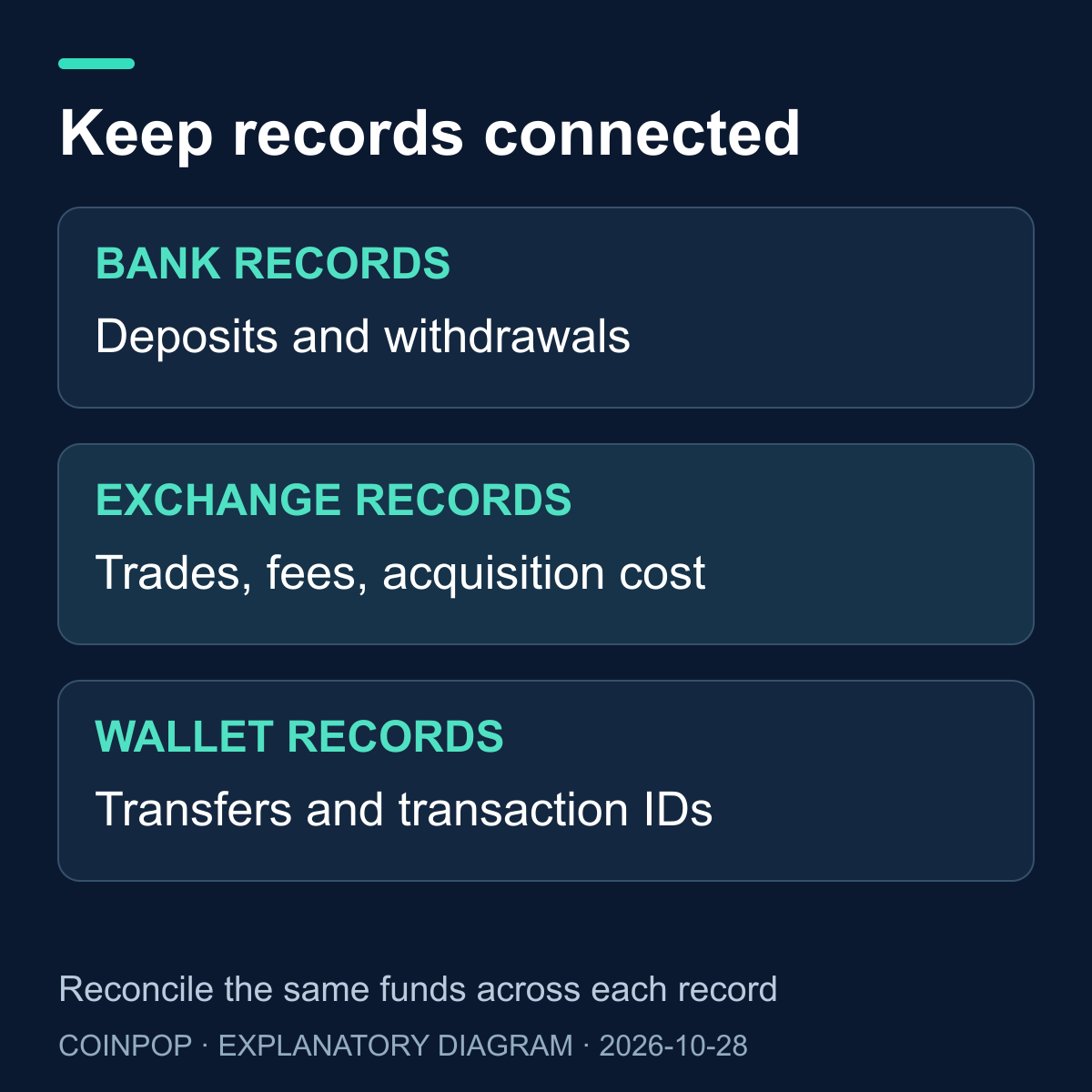
If you use an overseas exchange, it is important to link the source of funds → asset acquisition → transaction → wallet transfer → sale or withdrawal through a consistent set of records. A single balance screenshot or TXID alone does not prove the cost basis, source of funds, and tax treatment all at once.
- Obtain original records: Download the full transaction, deposit, withdrawal, and fee history from the exchange in an available format, and retain bank transfer and deposit/withdrawal records. Also record the date range, time zone, and base currency for CSV files.
- Distinguish acquisitions from disposals: Distinguish purchases, sales, exchanges, rewards, and fees, and link them to acquisition records. The cost-basis calculation method and conversion date must comply with the rules of the relevant country; do not assume that one calculation method applies in every country.
- Reconcile transfers between your own wallets: Link the withdrawal address, deposit address, network, TXID, timestamp, quantity, and fee to confirm whether the same asset was transferred. Ownership and the nature of the transaction must be supported by documentation.
- Record the reasons for discrepancies: Note the causes of any discrepancies separately—such as fees, time-zone differences, bridges or swaps, missing periods, and exchanges that have ceased supporting the service—and prepare a reconciliation table without altering the original records.
- Link to tax filing materials: Link tax returns, calculation support, and filing records in line with your place of residence and the rules for the relevant year. If you suspect a past omission, check the amendment procedures in the relevant jurisdiction. Retention periods, lookback periods, and penalty reduction rates cannot be stated as universal figures applicable worldwide.
Do not submit private keys or seed phrases as supporting evidence. Provide necessary materials, such as transaction records, public TXIDs, and account statements, through official procedures. If you are asked to prove wallet ownership, first verify the requesting authority and the verification method. Having supporting evidence does not eliminate filing obligations or exempt you from taxation or investigation.
7. Frequently Asked Questions About CARF
Do individual investors submit CARF XML files themselves?
Generally, the reporting entities under CARF are the applicable service providers. Individuals should verify the accuracy of requested information, such as tax residence and TIN, and separately review their own tax filing obligations. A separate assessment may be necessary if other circumstances apply, such as an individual operating as a business and qualifying as a reporting provider.
When will information on 2026 transactions be exchanged?
It varies by country. For example, the UK advises that domestic submissions for the 2026 reporting period are due by May 31, 2027, while the EU's first exchange of 2026 information is due by September 30, 2027. The UAE advises that its first exchange for the 2027 reporting period will take place in 2028. Do not infer an individual exchange's domestic filing deadline from the commitment year alone.
Are all exchange transactions transmitted in real time?
CARF's standard reporting structure consists of annual aggregates by asset and transaction type. This should be distinguished from retaining individual transaction records internally or providing them in response to a separate request from the authorities. Check the relevant jurisdiction's regulations for the actual domestic filing requirements.
Are transfers between my own wallets definitively treated as income?
The fact that a transfer is reported under CARF does not, by itself, establish taxable income. Determine whether it is simply a transfer between wallets you own or another type of transaction, such as an exchange, sale, or reward, and assess it under the tax laws of the applicable country. Keep transfer records linked so you can explain the nature of the transaction.
Will the introduction of CARF automatically make past transactions subject to a tax audit?
Information reporting and exchange do not, in themselves, mean that individuals will automatically be audited or that tax will be assessed retroactively across the board. Rules on past filings, information requests, audits, and assessment periods vary according to the laws and circumstances of the relevant country. Nor does CARF resolve issues with past filings.
How can duplicate reporting be checked when reports are made in multiple countries?
Businesses should first check the reporting jurisdictions and whether rules for adjusting duplicate reports apply, then link the underlying transactions, aggregates, filing identifiers, and correction records. Individuals should reconcile their records to ensure that transfers of the same assets are not misinterpreted as new acquisitions or disposals. Do not assume that reporting in one place automatically satisfies obligations in another country.
Official sources and correction notice
The information was verified on October 28, 2026. This summary is based on the OECD XML guidance and resource library, the list of countries' CARF commitments, and the links above to HMRC, the European Commission, and the UAE Ministry of Finance. A separate domestic filing deadline for Korea has not been confirmed here, so check the latest guidance from the Korean authorities.
Correction: We removed survey figures and testimonials from the previous text whose original sources and methodology could not be verified, and revised wording that could have been read as implying a blanket rollout in 2026 or automatic audits to reflect country-specific timelines and reporting structures. We also replaced all seven explanatory images. This article provides general guidance on the framework and recordkeeping; specific filing and tax determinations for individuals and businesses should follow the regulations of the applicable jurisdiction.

