

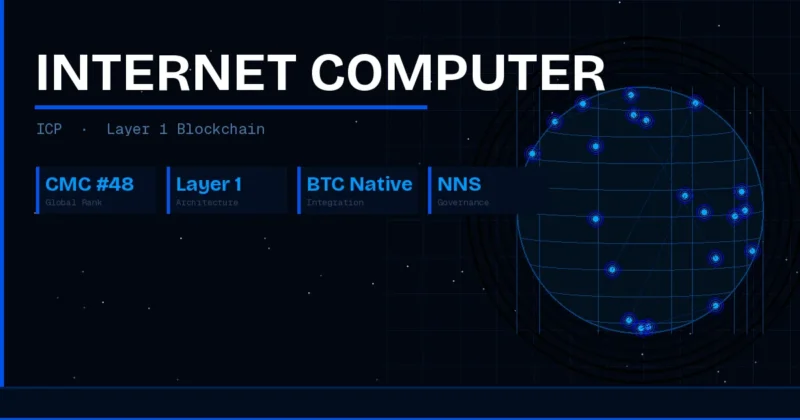
There is a coin that aims to change the internet entirely. It sounds grand, but this project was actually created to do just that. The core idea is to let the internet itself function like a computer, connecting nodes spread across the world without centralized servers like Amazon AWS or Google Cloud.
This is Internet Computer (ICP).
It is listed on both Upbit and Bithumb, making it easily accessible to domestic investors, and it consistently maintains its position within the top 50 by market cap on CoinMarketCap. However, this coin is accompanied by major controversies and incidents as much as its brilliant technical vision.
In this article, we will explain exactly what Internet Computer is, how it works, what happened in the past, and where it stands now.
What is Internet Computer?
Internet Computer (ICP) is a Layer 1 blockchain platform developed by the DFINITY Foundation, a Swiss non-profit research organization. Its official mainnet was launched on May 10, 2021.
While existing blockchains focused on “payments” or “smart contract execution,” Internet Computer goes a step further. Its goal is to run everything—websites, backend servers, databases, and APIs—directly on the blockchain, which normally runs on centralized clouds like AWS or Azure.
Founder Dominic Williams expressed this concept as follows: “The internet itself becoming a computer.” No servers are needed. There’s no need to pay Google or Amazon. If you upload the code, distributed nodes around the world execute it.
Comparison in One Sentence
- Bitcoin: Decentralized Currency
- Ethereum: Decentralized Smart Contracts
- Internet Computer: Decentralized Internet Computing Platform
The scale of the ambition itself is one of the greatest in cryptocurrency history. Whether that becomes a reality is a separate matter.
DFINITY Foundation and Development Background
The DFINITY Foundation is a non-profit research organization headquartered in Zurich, Switzerland, with offices in Palo Alto, San Francisco, and Tokyo. It employs over 200 developers and researchers, collectively holding more than 200 patents and over 100,000 academic paper citations. It is an organization that spans academia and industry, not just a simple startup.
Founder Dominic Williams is the inventor of cryptographic techniques such as Threshold Relay and Probabilistic Slot Consensus, and was an early member of the Bitcoin and Ethereum communities. The project idea itself emerged in 2015, and the foundation was officially launched in October 2016.
Major Investors
DFINITY has received massive investment compared to other cryptocurrency projects. It raised a total of over $121 million (approximately 160 billion KRW) from a16z (Andreessen Horowitz), Polychain Capital, Multicoin Capital, SV Angel, and others. Considering the 2018 funding round alone, it was about $195 million. It is one of the largest scales in the crypto industry.
In 2018, ICP tokens were distributed via airdrop to over 50,000 registered participants, and the alpha mainnet was launched in December 2020. Then, on May 10, 2021, the public domain launch took place along with the release of the entire source code.
Core Technical Structure – Canister, Subnet, NNS
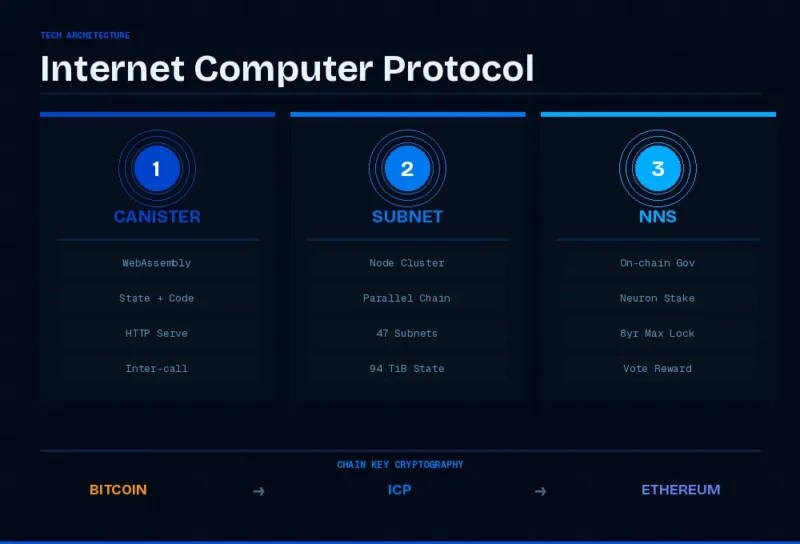
Internet Computer’s technology is unique. Because it uses concepts quite different from existing blockchains, it may feel unfamiliar at first. If you understand three core concepts, the entire structure becomes visible.
1. Canister – The Evolution of Smart Contracts
Smart contracts on Internet Computer are called Canisters. There is a decisive difference from general smart contracts. Canisters store code and data simultaneously and can directly provide HTTP content. Simply put, it means both the frontend and backend of a website can be contained in one canister and run on the blockchain.
Canisters can communicate with each other both synchronously (within the same subnet) and asynchronously (between subnets). This is the core structure that enables modular and scalable dApp development.
2. Subnet – The Secret of Parallel Processing
A Subnet is a collection of nodes distributed across data centers worldwide. Each subnet operates its own blockchain independently while executing canisters. As of 2025, it supports 94 TiB of replicated state capacity across 47 subnets, a figure that has recently expanded by 100%.
The important thing is that subnets operate in parallel. Instead of all transactions being processed sequentially on a single chain like Ethereum, multiple subnets process computations simultaneously, making scalability theoretically near-infinite.
3. NNS (Network Nervous System) – On-chain Governance
The NNS (Network Nervous System) is the on-chain governance system of Internet Computer. By staking ICP tokens to create Neurons, you can vote on proposals regarding network operations. Key decisions such as adding new subnets, approving node providers, and protocol upgrades are all made through the NNS.
The advantage of this method is that a centralized foundation does not make decisions unilaterally, and token holders can participate in actual governance. However, in reality, there are criticisms that the DFINITY Foundation’s influence is still significant (this part will be covered in detail later).
Chain Key Cryptography
Another unique technology of Internet Computer is Chain Key Cryptography. Thanks to this technology, ICP smart contracts (canisters) can directly create and sign transactions on other blockchains like Bitcoin and Ethereum. This structure enables native-level cross-chain functionality without the need for risky bridges.
The Role of ICP Token and Tokenomics
ICP tokens are not just speculative assets; they are utility tokens actually used in network operation. They play three core roles.
1. Governance Participation
Staking ICP in the NNS creates a neuron. By voting on proposals with neurons, you receive voting rewards. The longer the staking period, the greater the voting power and rewards, and it can be locked for up to 8 years.
2. Cycles Generation – Computing Fuel
Converting ICP into Cycles allows you to pay for canister execution costs. Cycles are burned when used. Developers charge canisters with cycles to run apps. This structure is conceptually similar to paying for server usage on AWS.
3. Node Provider Rewards
People who directly operate distributed nodes around the world receive ICP rewards. This is an incentive to maintain the physical infrastructure of the network.
Tokenomics – Balance of Inflation and Deflation
The initial supply was approximately 469.2 million ICP. As of March 2026, the circulating supply is about 540 million ICP. While inflation pressure continuously arises from staking and node rewards, deflationary pressure from cycles burned during canister execution balances it out.
According to community analysis, there is a possibility that the overall trend will shift to deflation once the scheduled token unlocks are completed and app usage increases.
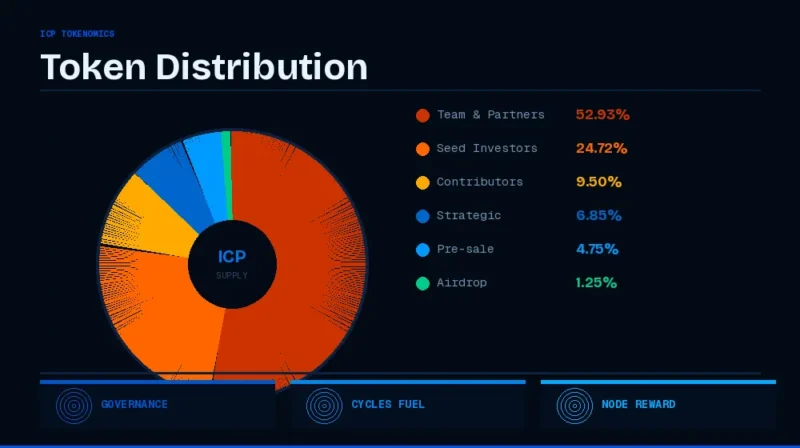
Initial Token Distribution Structure (Seed of Controversy)
- Foundation Grants/Team/Partners: 52.93%
- Seed Round Investors: 24.72%
- Early Contributors: 9.5%
- Strategic Investors: 6.85%
- Presale Participants: 4.75%
- Community Airdrop: 1.25%
This distribution structure became a major problem later. The airdrop ratio given to general investors was only 1.25%, while the team and investors held about 85% of the total supply. Remembering this makes it much easier to understand the incidents that follow.
Incidents – 2021 Launch Crash Controversy and Market Manipulation Allegations
This is the hottest chapter in Internet Computer’s history. No matter how great the technical vision is, leaving this part out results in incomplete information.
Launch Day – $630 → $250 Crash on the Same Day
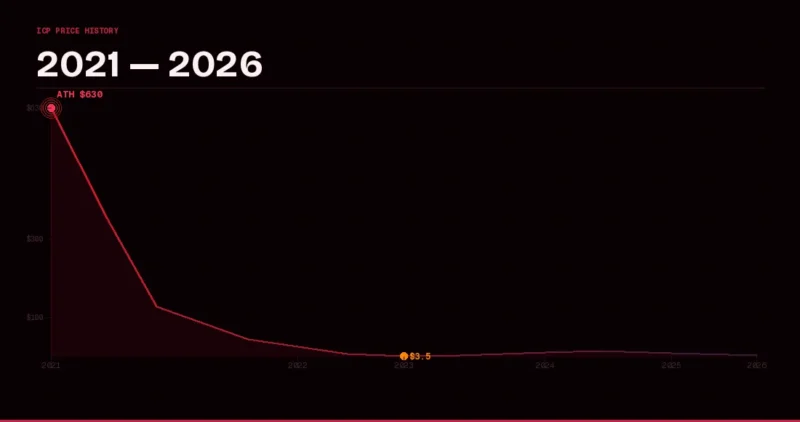
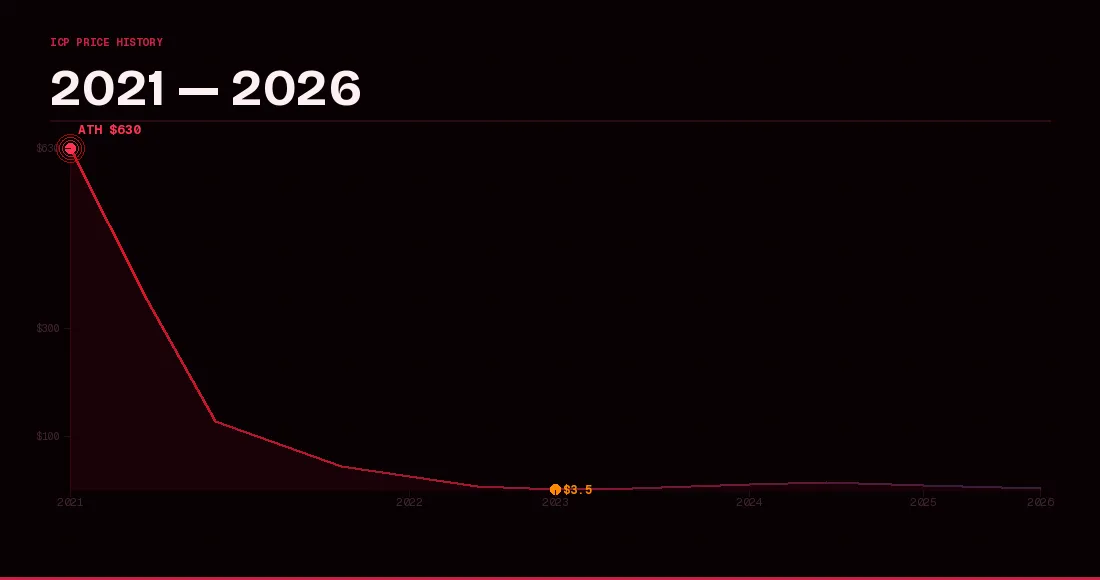
On May 10, 2021, along with the mainnet launch, ICP was simultaneously listed on Coinbase, Binance, Huobi, and OKX. The atmosphere was heated. Within a day of launch, it soared to 9th in global market cap, and the price hit a high of $630.
However, on the same day, the price plunged to $250. That’s a drop of nearly 60% in a single day. The decline didn’t stop there. The price, which was $440 in just a few months, collapsed to the $3 range by the end of 2022. It fell more than 99% from its peak.
Insider Dumping Allegations
Allegations were raised that it might not have been a simple market correction. It was claimed that insiders sold off massive amounts of their holdings immediately after the launch. Looking at the distribution structure earlier, the team and early investors held 85% of the total. Their unlock schedule coincided with the mainnet launch, and massive selling occurred at that point.
In fact, expressions like “one of the largest insider dumpings in the world” appeared in the community and media. General investors who participated in the flashy listing party suffered heavy losses.
Market Manipulation Allegations – CryptoLeaks Report
Even more serious allegations were raised. Cryptocurrency investigative outlet CryptoLeaks reported that there was collusion among certain parties to drive down the price after the ICP launch. In other words, it is claimed that someone intentionally pulled down the price of ICP.
The DFINITY Foundation strongly denied this. Emphasizing the transparency of NNS governance, they pointed out that the entire cryptocurrency market was in a downward trend at the time. Since the CryptoLeaks report was not independently verified, it remains unconfirmed whether these allegations are true. However, it is clear that this incident left deep scars on the community’s trust.
August 2025 – Odin.fun Security Vulnerability
In August 2025, an authentication vulnerability was discovered in Odin.fun, a platform within the ICP ecosystem. This incident triggered market volatility and led to ICP breaking below its $5.48 support level. At the same time, the overall cryptocurrency market was weak due to higher-than-expected US PPI (Producer Price Index), but ICP saw an unusual sell-off with trading volume surging by 86% compared to usual.
Continuous Centralization Criticism
There are also technical controversies. Critics point out that because the DFINITY Foundation holds a significant amount of the total ICP, it can exercise excessive influence over NNS governance. The criticism is that a project claiming to be decentralized is actually run by the foundation. The foundation counters that it is undergoing “progressive decentralization.”
Bitcoin Integration and Multi-chain Strategy
Technical development did not stop even in the shadow of incidents. One of the most notable recent upgrades for Internet Computer is native Bitcoin integration.
ICP canisters can directly store and transfer actual BTC through chain key cryptography. This is different from general cross-chain bridges. Bridges wrap BTC in a smart contract in the middle to use it on another chain, which is a key point of hacking risk. ICP can create and sign transactions directly on the Bitcoin network without a bridge.
Through this feature, ICP is being positioned as a smart contract layer for Bitcoin, or “Layer 0 for Bitcoin.” In 2024, the successful integration of Threshold Schnorr Signatures accelerated the building of the Bitcoin DeFi ecosystem.
Ethereum integration has also taken place. Through ICP native wrapped assets called ckBTC and ckETH, Ethereum ERC-20 assets can also be utilized within the ICP ecosystem.
2025~2026 Latest Trends
As of March 2026, the key trends for Internet Computer are summarized as follows.
Integration Discussions with Ripple Prime
In early 2026, discussions regarding the integration of Ripple’s institutional prime brokerage platform with the ICP ecosystem drew attention in the cryptocurrency community. Amid the trend of expanding decentralized finance accessibility for institutional investors, ICP’s multi-chain position is being highlighted.
Developer Ecosystem Expansion
In 2025, 11,774 developers and 1,554 projects participated in a global hackathon called World Computer Hacker League 2025. It is a sign that the developer base is growing rapidly. The subnet expansion upgrade announced by DFINITY via official X (Twitter) received over 2.1 million impressions, confirming high community interest.
CME Reference Rate Launch Plan
The world’s largest derivatives exchange, CME Group, announced plans to launch an ICP reference rate and real-time index in collaboration with CF Benchmarks. This is evaluated as a significant infrastructure piece that enhances institutional investment accessibility for ICP.
UNDP Partnership
The DFINITY Foundation has entered into a partnership with the United Nations Development Programme (UNDP). This collaboration for building blockchain-based public service infrastructure suggests the potential for expanding the real-world use cases of Internet Computer.
Ranked 1st in Development Activity
According to an analysis of blockchain project development activity by the cryptocurrency analytics platform Santiment as of December 2024, ICP ranked first overall with 409.63 points. It is noteworthy that it was dominant in actual development activity indicators such as code commits, issues, and PRs.
Price Status (As of March 2026)
On CoinMarketCap, it is fluctuating in the $3 to $5 range. The market cap is around 2 trillion KRW, maintaining its position in the global top 50. Although it has fallen more than 99% from its all-time high ($630), there were periods of meaningful recovery from its bottom (below $3) at the end of 2022.
Upbit·Bithumb Listing and Domestic Trading Information
Internet Computer (ICP) is listed on the KRW markets of both major domestic exchanges, Upbit and Bithumb. It is highly accessible to domestic investors as it can be purchased directly with Korean Won in the KRW market.
Upbit Trading Information
- Market: ICP/KRW
- How to Trade: Upbit App or Web → Enter “ICP” or “Internet Computer” in the search bar
- Available to buy immediately after depositing KRW
Bithumb Trading Information
- Market: ICP/KRW
- How to Trade: Bithumb App or Web → Search for ICP
- Available to buy immediately after depositing KRW
When Using Overseas Exchanges
If you want lower fees or futures trading, you can also use overseas exchanges. Refer to the referral links for major exchanges below.
CoinPop Full Exchange Information
Pros and Risks – A Cold Look
✅ Pros
Technical differentiation is clear. Technologies such as Canister smart contracts, Chain Key Cryptography, and NNS governance are unique in the blockchain industry. There are few competitors for the concept of running dApps at web speed and executing full-stack apps on-chain without servers.
Development activity is at the highest level in the industry. Ranked 1st in development activity according to Santiment. This is evidence that actual code work is being done, not just technical hype.
Native integration with Bitcoin and Ethereum. The ability to implement Bitcoin DeFi without bridge risks is a powerful position in the multi-chain era.
A project verified by large institutional capital. Top-tier crypto VCs like a16z and Polychain have invested large sums. While they can be wrong, it means the project has at least undergone thorough technical verification.
⚠️ Risks
The trauma of the 2021 crash is significant. The history of falling more than 99% from the peak cannot be erased. With insider dumping allegations not fully resolved, it is hard to say that community trust has been completely restored.
Practical user (adoption) issues. No matter how good the technology is, it’s meaningless if no one uses it. The dApp ecosystem is still small compared to Ethereum and Solana.
Centralization issues. DFINITY Foundation’s ICP holdings and influence remain high. Criticism persists that while it advocates for “decentralization,” it’s difficult to completely exclude the foundation’s influence in key decision-making.
Supply inflation. Tokens are continuously issued as staking and node provider rewards. While cycles burned offset this, if usage is insufficient, inflationary pressure weighs on the price.
Competition is fierce. In the decentralized computing field, it must compete with Ethereum and Solana, as well as specialized projects like Akash and Filecoin. The market itself is still forming.
Frequently Asked Questions
Q1. How much profit can I get by staking ICP?
Staking ICP in the NNS (creating a neuron) earns you voting participation rewards. It varies depending on the staking period and participation level, with higher rewards given for a maximum 8-year lock-up. For the specific current APY, we recommend checking the official internetcomputer.org dashboard in real-time. Some domestic exchanges also provide ICP staking products.
Q2. Is ICP mineable?
No. ICP is based on Proof of Stake and cannot be mined. Initial supply was through private sales and airdrops, and subsequent new issuance occurs only through staking rewards and node provider rewards.
Q3. What is the difference between Internet Computer and Ethereum?
Ethereum is a platform specialized for executing smart contracts. Internet Computer goes one step further, aiming to perform web content delivery and backend server roles directly on the blockchain. In terms of development languages, Ethereum is centered around Solidity, while ICP supports Motoko (its own language) and Rust.
Q4. How to safely store ICP?
In addition to exchange wallets, there is a self-custody method using Internet Identity. If you are handling multi-chain assets like ckBTC and ckETH, it is recommended to use an additional hardware wallet like OneKey.
Q5. How do I start developing on Internet Computer?
Developer documentation is provided on the official site (internetcomputer.org). You can write canisters in Motoko or Rust and deploy them using the DFINITY SDK (dfx). Recently, a web-based development environment called ICP Ninja was released, significantly reducing setup time.
Q6. Can the ICP price recover?
No one can give a definitive answer to this question. Listing only the cold facts: development activity is at the industry’s highest level, technical events like Bitcoin integration are continuously occurring, and institutional interest is rising. On the other hand, the trauma of insider dumping, poor ecosystem adoption, and inflationary pressure remain challenges. It is also a fact that historically, cases of coins recovering from a 99% drop from their peak are rare. Ultimately, you must judge for yourself.
Conclusion
Internet Computer (ICP) is one of the most ambitious projects in blockchain history. Its technical completeness is recognized in the industry, development activity is at the highest level, and a new narrative of Bitcoin integration has emerged.
At the same time, the 2021 launch crash and insider dumping allegations, structural centralization issues, and still limited ecosystem adoption are realities that must be viewed objectively. Excellent technology does not necessarily mean the price will rise, and it is hard to say that past trust erosion has been completely restored.
Before deciding to invest, it is right to understand both sides and judge within your own risk tolerance.
You can trade directly in KRW on both Upbit and Bithumb, and futures trading is also possible through overseas exchanges. Check CoinPop for related exchange information.
※ This article was written for informational purposes. Cryptocurrency investment carries the risk of principal loss, and investment decisions should be made based on your own judgment and responsibility.