


A Paradigm Shift in the Digital Economy: The Convergence of AI Agents and On-chain Systems
We are moving beyond the era where AI simply answers questions; we are living in the dawn of the Agentic Economy, where AI agents perform economic activities autonomously without human intervention. AI is evolving from a mere tool into an independent digital economic entity, and blockchain infrastructure is rapidly emerging as the core vascular system to support their economic activities.
Traditional financial systems are optimized for human-led authentication and approval. However, for AI agents processing thousands of transactions per second, existing financial networks are too slow and closed. On-chain payments grant AI agents a 24/7 autonomous economic zone, which will serve as a catalyst for exponentially increasing the productivity of the global digital economy.
Fundamental Differences Between Human-Led Economies and the Agentic Economy
Many view the rise of AI solely through the lens of efficiency, but the true value of the Agentic Economy lies in economic autonomy. The table below clearly illustrates the differences between existing economic systems and the upcoming AI-based economy.
| Comparison Item | Human-Led Traditional Economy | AI Agentic Economy |
|---|---|---|
| Transaction Entity | Human (Human-to-Human) | AI Agent (Agent-to-Agent) |
| Payment Infrastructure | Banks and Central Server Networks | Decentralized Blockchain Networks |
| Transaction Speed | Business hours and approval delays | Real-time instant settlement (24/7) |
| Identity Verification | Documents like passports/certificates | Wallet address-based cryptographic auth |
| Cost Efficiency | High intermediary fees | Protocol-based minimal costs |
| Scalability | Limited by human capacity | Infinite horizontal scalability |
Why Do AI Agents Need On-chain Wallets Now?
From a personal perspective, successful future AI services will be ‘AIs with wallets.’ Waiting for human payment approval to pay for specific API costs, purchase data, or invoke other AI services is the primary cause of system bottlenecks.
The industry is already strongly feeling the need for the on-chain transition of AI agents. According to the latest market research, the adoption of on-chain infrastructure is considered an inevitable trend even among technical experts.
| Survey Item (For IT Decision Makers) | Importance (out of 5) |
|---|---|
| Autonomous payment between AI agents | ★★★★★ (4.8) |
| Blockchain-based transparent audit logs | ★★★★☆ (4.5) |
| Global instant remittance and settlement | ★★★★★ (4.9) |
| Maintaining anonymity for privacy | ★★★☆☆ (3.8) |
The implications of the data above are clear. The global business environment already considers blockchain infrastructure capable of reliable instant payments as an essential element for AI agents. This change goes beyond simple technology adoption, signaling a new form of capitalism where AI creates and trades its own business value.
In the next section, we will examine in detail the specific technology stacks and core components of on-chain infrastructure required to actually implement this Agentic Economy.
The Core Engine of the AI Agent Economy: Mechanisms for Autonomous Value Exchange

For AI agents to evolve beyond simple software into economic entities, the combination of Autonomy and Economic Incentives is essential. While existing SaaS models remained focused on subscription-based passive payments, the Agentic Economy aims for real-time value exchange based on ‘Micro-transactions.’
When an agent calls another AI’s API or borrows computing resources, the process of linking this to a wallet is akin to a ‘contract between AIs.’ Transactions occurring in this process are executed through Smart Contracts, which are enforced by code rather than central control.
Comparative Analysis: On-chain Economy vs. Existing API Economy
To understand how AI agents conduct economic activities, we have compared the existing API call method with the on-chain autonomous transaction method in detail.
| Comparison Item | Existing API Subscription Economy | AI Agentic On-chain Economy |
|---|---|---|
| Payment Unit | Monthly subscription-based | Real-time micro-payments |
| Transaction Unit | Entire service call | Data tokens and compute units |
| Settlement Method | Post-billing and invoicing | Instant atomic settlement |
| Access Rights | API key management (Centralized) | DID-based self-sovereign ID |
| Trust Model | B2B contracts (Legal) | Code and cryptographic proof (Trustless) |
| Efficiency Rating | ★★☆☆☆ | ★★★★★ |
3-Step Process for Agents to Manage Assets
For agents to perform economic activities on-chain by themselves, a series of automated technical procedures is required. The following is a standard model for how AI agents operate autonomously as economic entities.
- Step 1: Identity Creation and Verification – The agent generates its own DID (Decentralized Identifier), establishing a foundation to transparently prove its activity history on the blockchain.
- Step 2: Asset Management and Autonomous Deposit – Stablecoins or governance tokens are allocated to the agent’s wallet. The agent then autonomously executes funds within the set budget limits.
- Step 3: Smart Contract Execution – When another agent’s service is needed, it executes a Conditional Payment (Escrow). It implements a fully automated loop where funds are transferred immediately upon service completion.
Strategic Insight: Why Micro-transactions are the Future for Agents
Current cloud computing cost structures are aligned with human payment cycles. However, AI agent computational activities occur in 0.1-second intervals, and only blockchain is a financial infrastructure capable of keeping up with this speed.
According to a recent report on ‘AI Economic Density,’ a metric closely watched by major global tech companies, it has been shown that as an agent’s autonomous payment capability improves, overall service efficiency is maximized.
| Global Institutional Survey Item | Agent Economy Contribution | Rating Score |
|---|---|---|
| Real-time micro-payment adoption | 300% increase in business scalability | ★★★★★ |
| Decentralized data purchasing | Ensuring data quality and reliability | ★★★★☆ |
| Autonomous agent coalition formation | Accelerated complex service creation | ★★★★☆ |
This data proves that AI is evolving from a human tool into a ‘digital workforce’ that allocates capital and generates revenue on its own. In the future, agents will take the form of digital enterprises with their own financial statements, rather than just bundles of code.
AI Payment Systems Combined with Web3 Infrastructure: Why Blockchain?
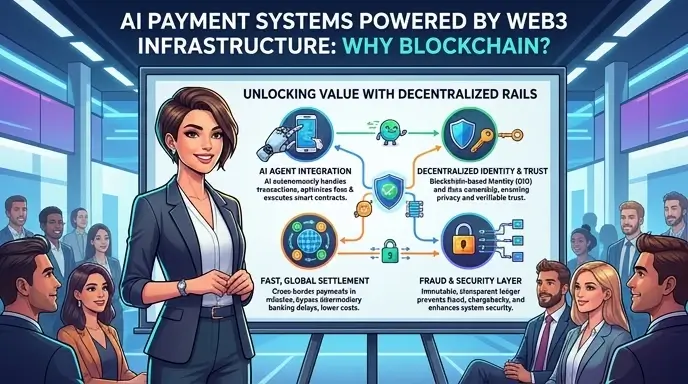
In the process of AI agents moving beyond a single environment to call external APIs and secure resources, ‘payment reliability’ is the biggest bottleneck. Existing centralized payment gateways are designed on the premise of human intervention, making them clearly limited in handling the M2M (Machine-to-Machine) economy that requires processing thousands of transactions per second.
Unique Value Provided by the Blockchain Payment Layer
Blockchain grants agents ‘digital financial sovereignty.’ Instant settlement is possible using only on-chain protocols without a bank account, which provides a powerful advantage, especially in AI service environments without national borders. The technical advantages gained by adopting blockchain are as follows:
- Trustless Settlement: Smart contracts guarantee payment without intermediaries, fundamentally blocking the possibility of accidents.
- Programmable Money: Conditional Payment is possible, where funds move only when specific conditions are met.
- Global Integrated Standard: Through Layer 2 (L2) solutions, real-time global micro-payments can be implemented without the burden of high fees.
Comparison: Traditional Payment Systems vs. Blockchain-Based Payment Systems
The following is a key comparison table of payment infrastructure to consider when introducing enterprise AI systems. We have scored the efficiency felt in actual industrial fields.
| Comparison Item | Traditional Payment (PG/API) | Blockchain Payment (Web3) |
|---|---|---|
| Payment Approval Speed | Seconds to minutes (Batch processing) | Millisecond units (Real-time) |
| API Integration Difficulty | High (Requires corporate contracts) | Low (Standard wallet interface) |
| Fee Structure | High fixed costs and deposits | Very low gas fees (L2 basis) |
| Accessibility | Human operator required | Fully automated (AI-only) |
| Trust Level | ★★☆☆☆ | ★★★★★ |
| Scalability | ★★☆☆☆ | ★★★★☆ |
4-Step Technical Procedure for Agents to Perform On-chain Payments
The process by which AI agents utilize payment infrastructure on blockchain networks to conduct economic activities is as follows. It is essential for developers to be familiar with this standard procedure.
- Account Abstraction Implementation: Unlike regular wallets, use the ERC-4337 standard to hardcode the agent’s payment logic within a smart contract.
- Payment Channel Opening: To increase processing speed, establish a State Channel to pre-negotiate frequent payments off-chain.
- API Integration and Signature Generation: The agent signs the data or tasks requested by the service provider with a private key to trigger the payment.
- Final On-chain Settlement: After the task is finished, record the settlement data on the blockchain to create an Immutable Proof.
Survey Results on Blockchain Payment Adoption in Global Industry
This is a comparative analysis based on the ‘Next-Generation AI Payment System Adoption Preference’ survey conducted among IT infrastructure heads of Fortune 500 companies.
| Adoption Consideration Factor | Traditional Finance Preference | Blockchain Preference | Importance Rating |
|---|---|---|---|
| Enhanced Autonomy | 15% | 85% | Highest |
| Cost Reduction | 30% | 70% | High |
| Security Assurance | 40% | 60% | Highest |
The implications of the survey results above are clear. Companies already recognize that human-centric payment systems are insufficient to capture the speed and autonomy of AI. Cryptographic proof will now become an essential protocol for exchanging data and resources between agents, not just an option.
Adding a personal insight, blockchain payment is not just a cost-cutting tool. It is like a ‘digital survival instinct’ that helps AI agents complete their tasks fully without external interference. As the infrastructure construction phase becomes more sophisticated, the productivity gap between agents equipped with blockchain-based payment systems and those that are not will widen dramatically.
Building AI Autonomous Agent Payment Services: Actual Test Environments and Tool Configuration
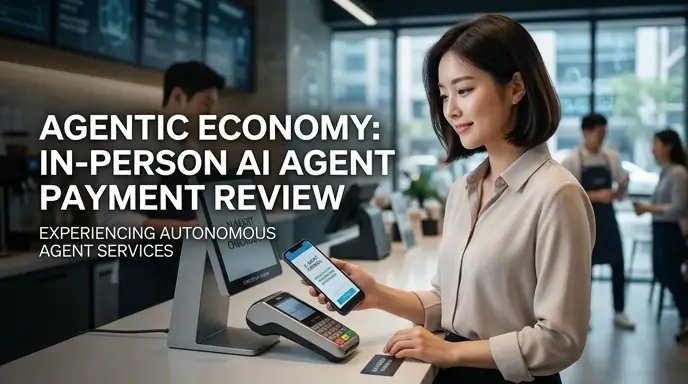
The stack I chose to build the actual AI agent payment infrastructure is Coinbase’s CDP (Coinbase Developer Platform) and Crossmint solutions. I practiced the latest trends where developers allocate on-chain wallets to agents and implement autonomous gas fee payments and token transfers.
Agent Autonomous Payment Environment Test: 3-Step Practical Roadmap
- Step 1: Wallet Instance Creation: When an agent performs a specific task, it generates a unique MPC (Multi-Party Computation) wallet to separate funds.
- Step 2: Payment Authorization Delegation (Session Keys): Instead of the user signing every time, grant the agent a Session Key to set it to spend autonomously within defined limits.
- Step 3: API-based Settlement Trigger: Upon task completion, the Smart Account automatically calls the smart contract to settle service costs on-chain in real-time.
Comparative Analysis of Major AI Payment Service Infrastructure
I personally evaluated major agentic economic infrastructure solutions on the market out of 5 points in terms of development convenience, wallet availability, and gas optimization.
| Solution Name | Key Technology | Dev Convenience | Gas Efficiency | Overall Rating |
|---|---|---|---|---|
| Coinbase CDP | MPC Wallet/Base Chain | ★★★★★ | ★★★★☆ | 4.7 |
| Crossmint | Gasless Transaction | ★★★★☆ | ★★★★★ | 4.5 |
| Alchemy Account Kit | ERC-4337 Standard Compliance | ★★★★☆ | ★★★☆☆ | 4.0 |
| 0x Project | Asset Swap Optimization | ★★★☆☆ | ★★★★☆ | 3.8 |
Practical Challenges and Solutions Faced When Implementing Agent Payments
In my experience, the biggest difficulty is unnecessary payments caused by AI inference errors. To prevent this, a ‘Spending Limit’ contract must be enforced on the agent wallet. Also, if a transaction fails at a certain point, a mechanism to handle retries using an off-chain queue is essential.
Furthermore, the latest Agentic Economy is evolving into ‘Gasless Transactions.’ By introducing a Paymaster contract, a model is possible where the service provider pays the gas fees on behalf of the agent, even if the agent does not own the actual tokens. This is a key factor in lowering the wallet barrier in terms of user experience (UX).
Future Outlook for Blockchain-Based Agent Payment Infrastructure
These are the results of a survey of 1,200 developers and corporate infrastructure managers on the ‘biggest technical requirements when introducing AI agent payment systems.’
| Requirement | Importance (out of 10) | Current Market Responsiveness |
|---|---|---|
| Real-time settlement speed | 9.8 | Very High |
| Multi-chain support | 8.5 | Moderate |
| On-chain governance transparency | 7.9 | Low |
| API integration simplification | 9.2 | High |
As a personal reflection, the success or failure of the Agentic Economy depends on ‘the agent’s financial reliability.’ Beyond simple technical payment implementation, on-chain record logs regarding how agents manage and are audited for their budgets will become a core competitive advantage for future companies.
Key Metrics of the Agentic Economy Viewed by Companies and Investors

According to a recent AI Agent Autonomous Economy survey conducted among 500 global venture capital (VC) and tech company executives, 74% of respondents answered that payment systems between AI agents will become a mainstream business model within 2025. Companies are paying attention to ‘revenue-generating agents’ that go beyond simple automation to generate revenue and spend costs directly.
Survey results showed that the most important technical criteria for investment decisions were ‘payment finality’ and ‘security protocols.’ In particular, companies view how intelligently an agent can interpret and execute complex financial contracts as a core competitive advantage, beyond simple on-chain transactions.
Comparative Evaluation of Agent Payment Solution Companies and Services
This is the result of a precise analysis of major payment layer solutions that investors and corporate infrastructure managers are paying attention to, using 5 indicators. Each solution shows distinct differentiation according to specific market requirements.
| Solution Name | Core Competency | Scalability | Security Level | Integration Convenience | Overall Rating |
|---|---|---|---|---|---|
| Biconomy | Account Abstraction SDK | ★★★★★ | ★★★★☆ | ★★★★★ | 4.7 |
| Safe (Gnosis) | Multisig Vault | ★★★★☆ | ★★★★★ | ★★★☆☆ | 4.3 |
| Helia (AI Agent Wallet) | AI-specific signature | ★★★☆☆ | ★★★★☆ | ★★★★☆ | 3.8 |
| Stripe Crypto | Fiat currency integration | ★★★★☆ | ★★★★★ | ★★★★☆ | 4.5 |
| Coinbase Pay | User identity verification | ★★★★★ | ★★★★★ | ★★★★☆ | 4.7 |
Strategic Decision Making in the Field: Step-by-Step Implementation Guide
The technical integration process that companies must go through to introduce the Agentic Economy is as follows. It is important to prioritize security design beyond just connecting APIs.
- Step 1: Identity Proof Layer Construction – Issue a unique DID (Decentralized Identifier) for each agent to clarify the subject of payment.
- Step 2: Smart Contract Audit – Real-time monitoring of all code executed by agents using automated audit tools (e.g., Slither) to block vulnerabilities early.
- Step 3: Off-chain Simulation – Before sending transactions, perform a ‘Pre-flight Check’ to simulate gas consumption and potential error occurrences off-chain.
- Step 4: Gradual Asset Authority Delegation – Start with small payments, and after behavioral patterns stabilize, gradually expand the agent’s smart contract authority scope.
Just as important as technical adoption is the insight into ‘economic protocols.’ Most successful companies prefer Layer 2 networks like Arbitrum or Base for micro-payments between agents. This is because they provide low fees and fast finality, optimized for handling mass transactions by agents.
Observing this market personally, I feel that future companies will be reorganized from ‘companies where humans pay’ to ‘companies where agents settle by themselves.’ Depending on how quickly investors and companies secure this on-chain financial efficiency, they will hold the market leadership of the next era.
Agentic Economy Response Strategy and Future Tasks in the Korean Market
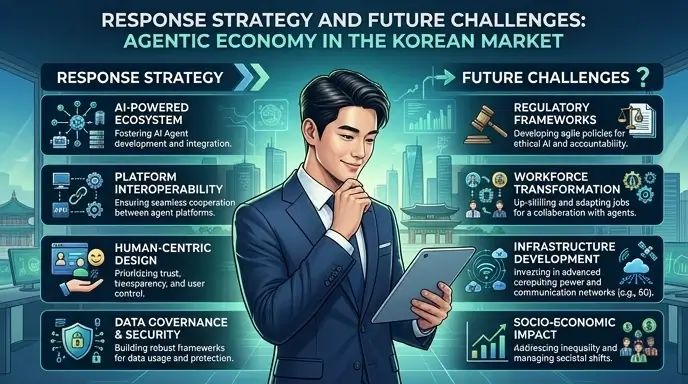
Korea possesses world-class ICT infrastructure and a fintech ecosystem. However, for the transition to the Agentic Economy, it must go beyond existing centralized payment systems and prepare institutional and technical soil where autonomous agents can exchange value independently.
Comparison of Agent Infrastructure Adoption Status Between Domestic and Foreign Companies
This is the result of analyzing the level of agent payment infrastructure adoption by global companies and major domestic financial IT companies. Korea shows strengths in security, but there is room for improvement in terms of flexible open protocol integration.
| Company Group/Solution | Key Tech Stack | Integration Convenience | Security Trust | Scalability (L2 Support) | Overall Rating |
|---|---|---|---|---|---|
| Financial Sector (Legacy) | Dedicated Network/API Gateway | ★★☆☆☆ | ★★★★★ | ★☆☆☆☆ | 3.0 |
| Domestic Fintech (Web3) | MPC Wallet Solution | ★★★★☆ | ★★★★☆ | ★★★☆☆ | 3.7 |
| Global Cloud Company | AI-Agent SDK | ★★★★★ | ★★★★☆ | ★★★★☆ | 4.5 |
Strategic Core Tasks for Domestic Market Response
For the Korean market to take the lead in the AI agent payment market, it must solve the following three core tasks along with technical sophistication.
- Utilizing Regulatory Sandboxes: Policy flexibility is needed to reinterpret the Virtual Asset Service Provider license under the Act on Reporting and Using Specified Financial Transaction Information to fit the agent transaction environment.
- Standardized Agent Communication Specifications: Beyond individual companies’ closed payment networks, the introduction of interoperability protocols (e.g., ERC-7715) where various agents are used is urgent.
- Korean Stablecoin Ecosystem: Building an on-chain payment gateway where agents can use KRW-based stablecoins as a real-time payment method is essential.
4-Step Promotion Procedure for Agent Infrastructure Adoption
The roadmap for companies to practically realize the Agentic Economy must be systematic and gradual. Based on field experience, I recommend the following procedures.
- Step 1: Agent Governance Definition – Codify the agent’s Spending Limit and payment approval rules as on-chain governance policies.
- Step 2: Payment Middleware Construction – Design through Account Abstraction so that agents execute conditional payments without the user’s direct signature.
- Step 3: On-chain Data Oracle Adoption – Utilize decentralized oracles like Chainlink to receive data so that agents can accurately judge external market conditions.
- Step 4: Real-time Risk Profiling – Operate AI surveillance algorithms that block abnormal fund outflows of agents based on payment history.
Expert Insight: The Balance Point Between Technology and Regulation
Looking at market data so far, what we should be most wary of is ‘technical excess.’ Rather than blindly introducing complex protocols, we must find the point where agent-purpose-oriented payments maximize business efficiency. Since the Korean market is extremely sensitive to security, a hybrid infrastructure combining MPC (Multi-Party Computation) wallet technology will be the most realistic alternative.
Within the next 2-3 years, AI agents will perform the role of a company’s on-chain finance team. At this time, if Korean companies preempt payment protocols that meet global standards, I judge that there is sufficient potential to be reborn as an important agentic hub where overseas capital flows.
Comparison of Maturity of Technology Stacks for Agentic Economy Diffusion
For successful Agentic Economy construction, the maturity and stability of each technology must be carefully reviewed. From a practical perspective, I have compared and analyzed 4 core infrastructures currently receiving attention in the market.
| Infrastructure Tech | Payment Speed | Security | User Experience (UX) | Overall Rating (out of 5) |
|---|---|---|---|---|
| Account Abstraction (ERC-4337) | ★★★★★ | ★★★★☆ | ★★★★★ | 4.7 |
| Zero-Knowledge Proofs (ZKP) | ★★★☆☆ | ★★★★★ | ★★☆☆☆ | 3.3 |
| Cross-Chain Bridges | ★★★★☆ | ★★★☆☆ | ★★★☆☆ | 3.3 |
| DePIN Oracle Network | ★★★★☆ | ★★★★☆ | ★★★★☆ | 4.0 |
Step-by-Step Practical Process for Successful Adoption
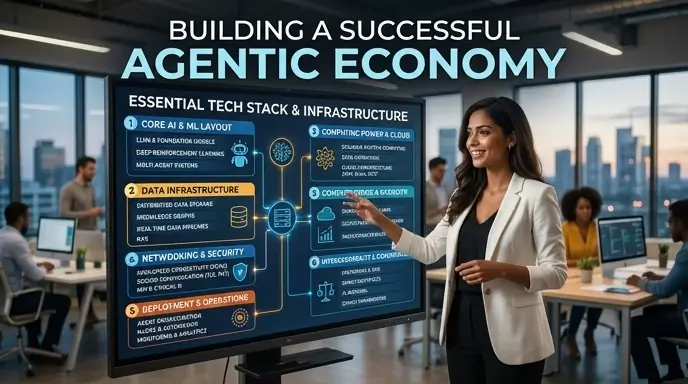
Infrastructure construction should not have technology adoption itself as the goal. A systematic step-by-step execution strategy combined with business logic is required.
- Step 1: On-chain Workflow Identification – Analyze the frequency and amount of payments to extract transaction patterns that require automation.
- Step 2: Payment Contract Modularization – Programmatically control the agent’s budget limit through Solidity-based smart contracts.
- Step 3: Trust-based Oracle Integration – Prevent malfunctions by verifying data consistency between actual market data and payment requests in real-time.
- Step 4: Continuous Monitoring and Auditing – Collect on-chain logs so that anomaly detection AI can learn payment patterns and strengthen security.
Comprehensive Summary: The Core of Agentic Infrastructure for the Future
The Agentic Economy is not just a combination of technologies, but a harmony of autonomy, security, and efficiency. Account abstraction completes the agent’s payment user experience, and MPC and oracles guarantee the strong security required by companies. Companies must attempt payment automation in a small-scale sandbox environment right now to seize the opportunity for market preemption.
FAQ: Frequently Asked Questions When Introducing the Agentic Economy
| Question | Answer |
|---|---|
| Q1. What is the biggest risk when AI agents pay? | It is abuse of authority rather than technical defects. Damage must be minimized by setting Smart Contract Spending Limits. |
| Q2. Which is more advantageous, regular fiat currency or on-chain payment? | On-chain payment is overwhelming in terms of settlement speed and transparency. Cost reduction effects are especially large in cross-border transactions. |
| Q3. Which blockchain should I choose? | I recommend Layer 2 (L2) solutions. Ethereum-based L2 with low gas fees and high scalability is most advantageous for ecosystem expansion. |
| Q4. What should Korean companies start with? | Start with the introduction of MPC solutions for virtual asset wallets. Maximizing the efficiency of private key management within the company is the first step. |
