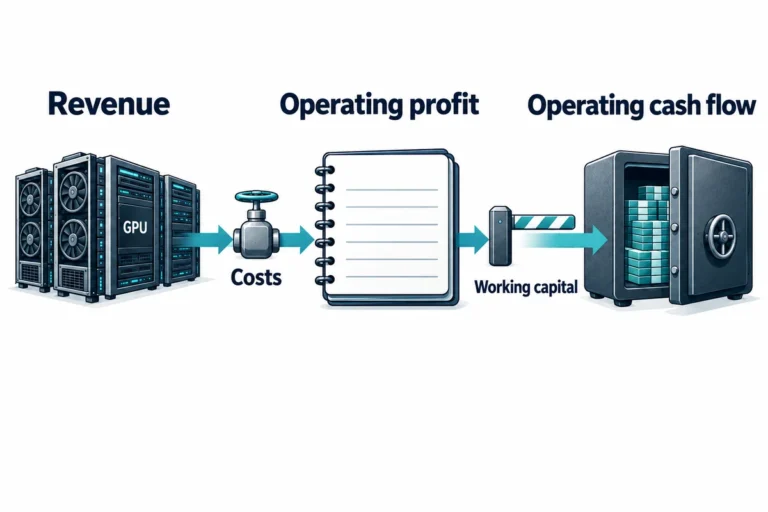

Tesla stock’s investment value is difficult to assess based on delivery growth alone. Vehicle deliveries in the third quarter of 2026 exceeded the market estimate compiled by the company, but energy storage deployments were lower than expected, and third-quarter earnings and cash flow have not yet been reported. CoinPop’s view is that there is reason to assess the potential for business expansion, but it is difficult to conclude that the stock is “cheap” before verifying earnings and the expectations embedded in the price.
Subject of analysis: Tesla, Inc. common stock (NASDAQ: TSLA) · Writing and official-source verification as of: 2026-10-13 KST · Edited and verified by: CoinPop Editorial Team. This article provides general investment information and is not personalized advice to buy or sell. Earnings figures are for the applicable fiscal periods, and the valuation examples below are calculation assumptions—not actual stock prices, market forecasts, or price targets.
1. Tesla’s third-quarter deliveries: Beating expectations and declining year over year can both be true
Tesla announced its third-quarter operating figures on 2026-10-02. The starting points for comparison are the actual production and delivery announcement, the analyst estimate compiled by the company on 2026-09-29, and the announcement for the same period last year. The fact that the company compiled the estimates does not mean it endorsed them or adopted them as its own guidance.
| Metric | Actual, third quarter 2026 | Comparison basis | CoinPop calculation and interpretation |
|---|---|---|---|
| Vehicle deliveries | 486,532 vehicles | Company-compiled average estimate: 461,974 | 24,558 vehicles, about 5.32% above estimate |
| Quarter-over-quarter deliveries | 486,532 vehicles | Second quarter 2026: 480,126 | Up about 1.33% |
| Year-over-year deliveries | 486,532 vehicles | Third quarter 2025: 497,099 | Down about 2.13% |
| Difference between production and deliveries | Production: 464,391 vehicles | Deliveries: 486,532 vehicles | Deliveries exceeded production by 22,141 vehicles |
| Energy storage deployments | 13.7 GWh | Company-compiled average estimate: 15.9 GWh | 2.2 GWh, about 13.84% below estimate |
Percentage changes are calculated as “actual ÷ comparison value − 1” and rounded to two decimal places. The delivery estimate is compiled from 24 firms, and the storage deployment estimate from 19. The percentage by which results exceed expectations will vary if consensus estimates from different aggregating firms are mixed. Beating expectations means performing better than the estimate; it does not mean year-over-year growth or increased earnings.
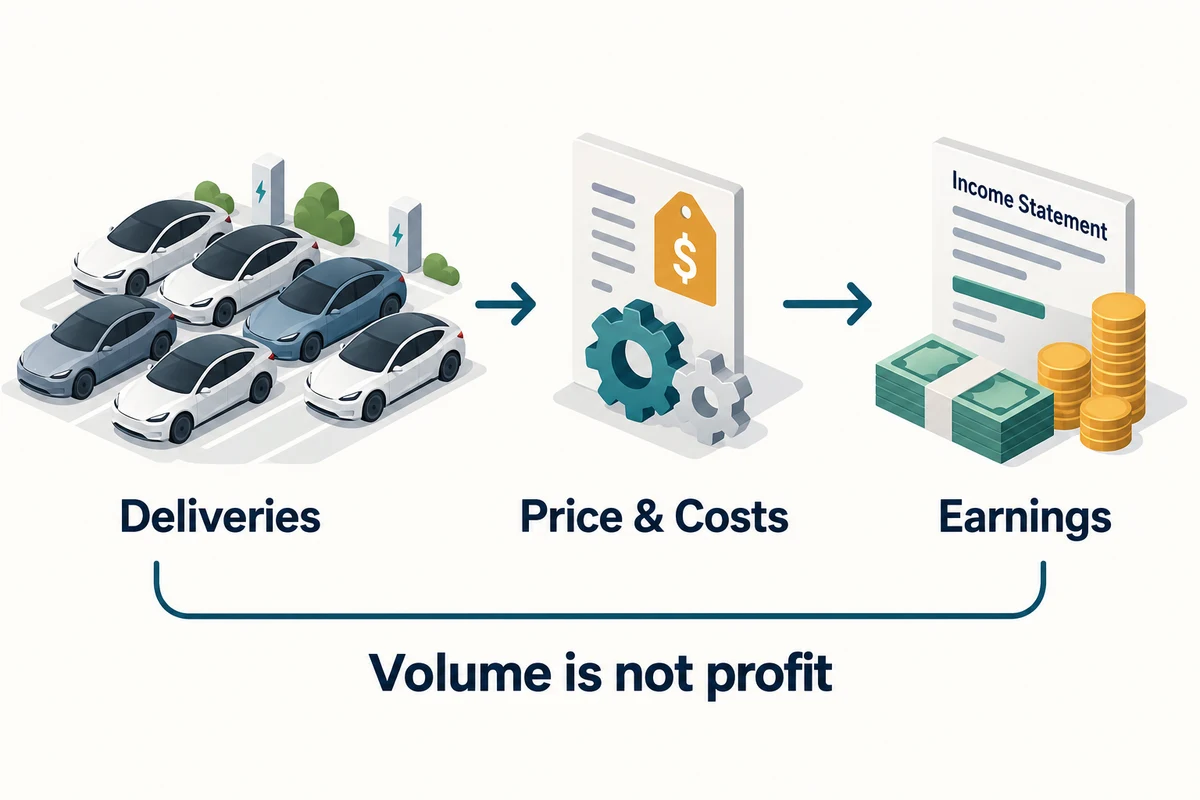
The fact that deliveries exceed production is a reason to examine changes in inventory and vehicles in transit. However, that difference alone does not establish that ending inventory fell by exactly the same number or that cash flow improved. Inventory scope, delivery recognition, regional logistics, and working capital should be checked in the actual financial statements.
Confirmed schedule: The company is scheduled to release its third-quarter results after the U.S. market closes on 2026-10-21 and hold a Q&A at 17:30 U.S. Eastern Time. The Q&A corresponds to 2026-10-22 06:30 Korea time; this does not mean the earnings materials will be posted at precisely that time. As of the reference date, third-quarter operating income, net income, and cash flow have not been reported.
2. Tesla investment analysis should distinguish automotive, energy, and future businesses
For automotive sales, it is not only volume that matters, but also actual selling prices, costs, and the ability to sustain prices. For energy, deployment volumes and the timing of revenue recognition under contracts should be considered alongside profitability. For software, autonomous driving, and robotics, distinguish revenue already being generated from business opportunities that remain to be validated. Do not aggregate everything on the assumption that all future businesses are already generating substantial standalone profits.

The most recently available quarterly financial statements, the second-quarter 2026 SEC 10-Q, show why volume and earnings should be considered separately. The figures below are in millions of U.S. dollars and are actual GAAP results.
| GAAP metric | Second quarter 2026 | Second quarter 2025 | What to look for |
|---|---|---|---|
| Revenue | 28,236 | 22,496 | Whether revenue growth is accompanied by operating income growth |
| Operating income | 398 | 923 | Core business earnings remaining after higher costs |
| Operating margin | About 1.41% | About 4.10% | Calculated directly as operating income ÷ revenue |
| Net income attributable to common stockholders | 1,114 | 1,172 | Final earnings, including non-operating income and expenses, taxes, and other items |
| Diluted EPS | $0.32 | $0.33 | Per-share earnings reflecting dilution |
CoinPop analysis: Revenue can increase even as the operating margin declines. Therefore, the key issue in the next earnings report is not to verify deliveries again, but to determine how much of the additional revenue converts into earnings. Looking only at net income could lead investors to mistake the effects of non-operating income and expenses or taxes for a recovery in core profitability.
What do you miss by classifying Tesla solely as either an automotive or an AI company?
Comparing Tesla only with traditional automakers may overlook the optionality of new businesses, while viewing it only as an AI company may overlook manufacturing costs, capital requirements, and service obligations. Comparisons should use the same fiscal period, GAAP basis, and share dilution criteria, and should not double-count automotive earnings and future earnings that have yet to be validated. This article does not force comparisons by listing multiples for peers using inconsistent criteria.
3. Growth investments and free cash flow: Cash after investment is different even when there are earnings
In the same 10-Q, operating cash flow for the first half of 2026 was $8,634 million, while purchases of property and equipment, less disposals and excluding finance leases, totaled $8,282 million. The simplified free cash flow calculation in this article is 8,634 − 8,282 = $352 million. This is the first-half total, not a standalone second-quarter figure, and it is not a definition that includes all cash uses such as purchases of investments and acquisitions.
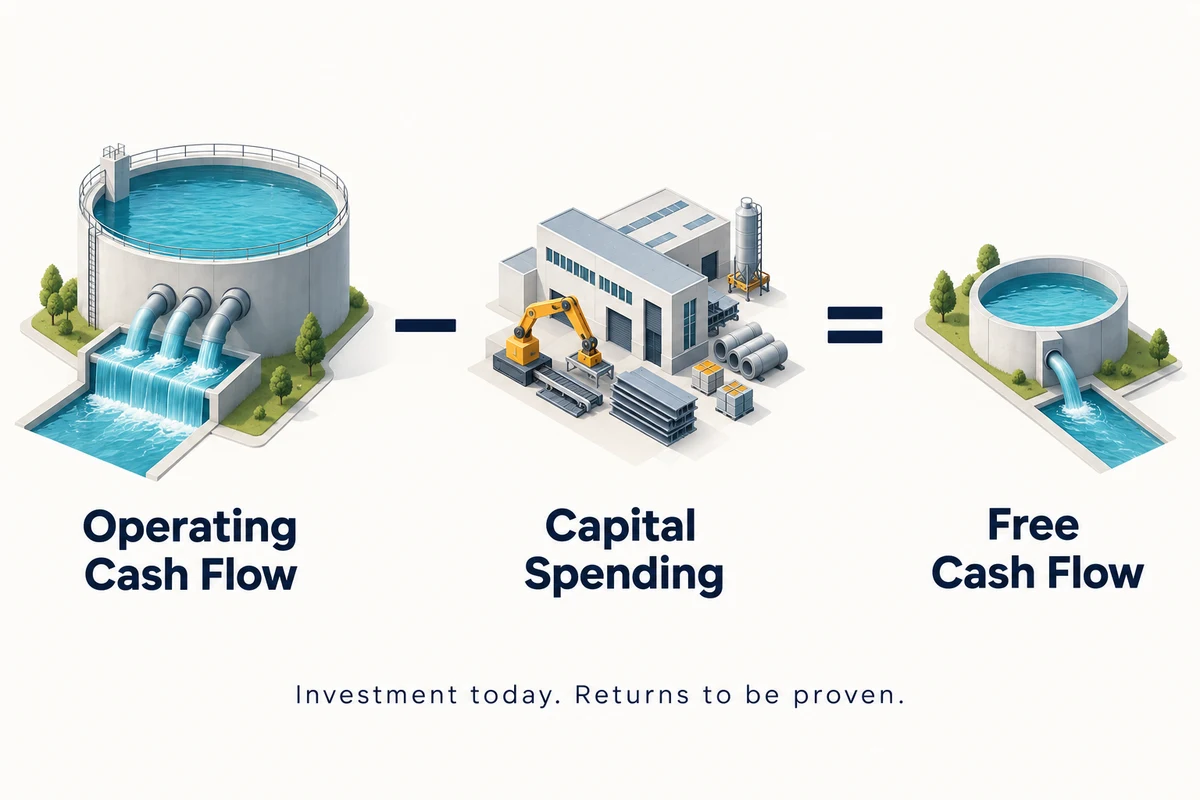
The company disclosed that it expects capital expenditures in 2026 to exceed $25 billion. This is a company forecast, not a confirmed level of spending or a guarantee of investment returns. Such spending may build long-term competitiveness, but if the amount and timing of the cash it will generate in return are unclear, shareholder risk also increases. The key question is not “Is the company investing a lot?” but “How sustainably will those investments generate cash per share?”
Cash flow in a single quarter is affected by inventory, accounts payable, and the timing of customer payments. Distinguish temporary working capital effects from repeatable cash generation, and separately consider both the reduction in cash outflows from stock-based compensation and the potential dilution of existing shareholders.
4. Is Tesla stock attractively priced? Work backward from expected earnings
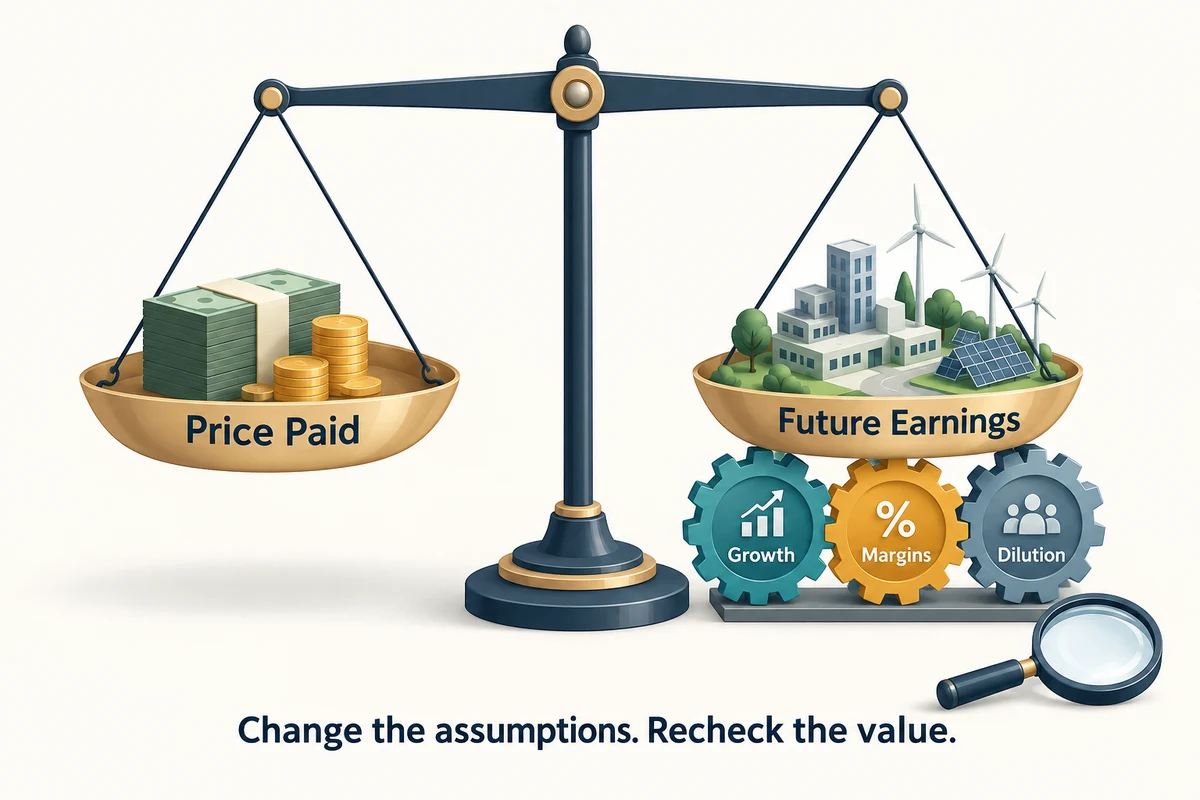
A good business and a good investment price are not the same thing. Valuation examines what growth is required, how much investment it would take to achieve that growth, and what price burden would arise if results were slower or smaller than expected. Because real-time stock prices as of the reference date and peer multiples at the same point in time were not sufficiently cross-checked, this article does not definitively characterize the stock as undervalued or overvalued, nor does it provide a real-time price target.
| Calculation assumptions | Assumed annual diluted EPS | Simple price-to-earnings ratio | Limitations of interpretation |
|---|---|---|---|
| Assumed share price: $380 | $2 | 190x | 380 ÷ 2. Not an actual forecast |
| Same assumed share price | $4 | 95x | Even if earnings double, the valuation multiple may remain burdensome |
| Same assumed share price | $8 | 47.5x | Assess the timing of earnings realization, sustainability of growth, and risks separately |
The EPS figures above are not forecasts for any specific year or company guidance. The current fair price cannot be determined solely by dividing distant future earnings by the current share price; the time value of money, additional dilution, and reinvestment must also be considered. Conversely, a low multiple does not prove that a stock is cheap if earnings are declining or nonrecurring.
Interest rates can affect the discount rate applied to future cash flows and the returns investors require. To understand this mechanism, see How to distinguish FOMC decisions from the dot plot. A rate cut does not automatically guarantee a rise in Tesla's share price. The relationship between inflation reports and rate expectations is explained separately in The difference between CPI and PCE and how to interpret their releases.
5. Is it worth investing now? Three conditions that could change the assessment
Conditional conclusion: Tesla warrants analysis across its automotive and energy businesses as well as its new business opportunities. However, this delivery report alone does not provide sufficient grounds for an aggressive buy recommendation. The case for considering an investment becomes stronger when repeatable earnings, cash after investment, and per-share growth after dilution are confirmed, and when the price paid does not depend solely on optimistic assumptions.
| Analysis scenario | Conditions to check | Investment considerations | Why the assessment could be wrong |
|---|---|---|---|
| Upside scenario | Selling prices and cost management, margin recovery, energy profitability, progress in recouping investments | Assess whether growth translates into per-share earnings and cash | Even if the business improves, that may already be fully reflected in the price |
| Base scenario | Volumes hold steady, but costs and investment offset the gains | Wait for further results and assess the gap between expectations and outcomes | Current indicators may reflect long-term investment performance only with a lag |
| Downside scenario | Price competition, low margins, commercialization delays, regulatory and dilution risks, and investment burdens | Reassess growth assumptions and valuation concerns | New products and cost improvements could also mitigate risks |
The categories above are an analytical framework for considering possibilities; they do not predict probabilities or share price direction. An analysis that cites only the market size of autonomous driving and robotics while omitting actual paid usage, profitability, and legal liability is incomplete. Conversely, assigning zero value to all future businesses based solely on current automotive profitability is also an assumption.
What matters to different readers?
Readers considering Tesla for the first time should first separate positive delivery news from an assessment of the company's value. Existing shareholders should check whether their original investment thesis still holds and assess concentration risk in the same stock. Readers approaching an earnings event should consider the potential for increased volatility and their own tolerance for losses. For Korean investors, exchange rates, currency conversion, and transaction costs also affect actual returns, beyond the share price in dollars.
6. Checklist for the next earnings release
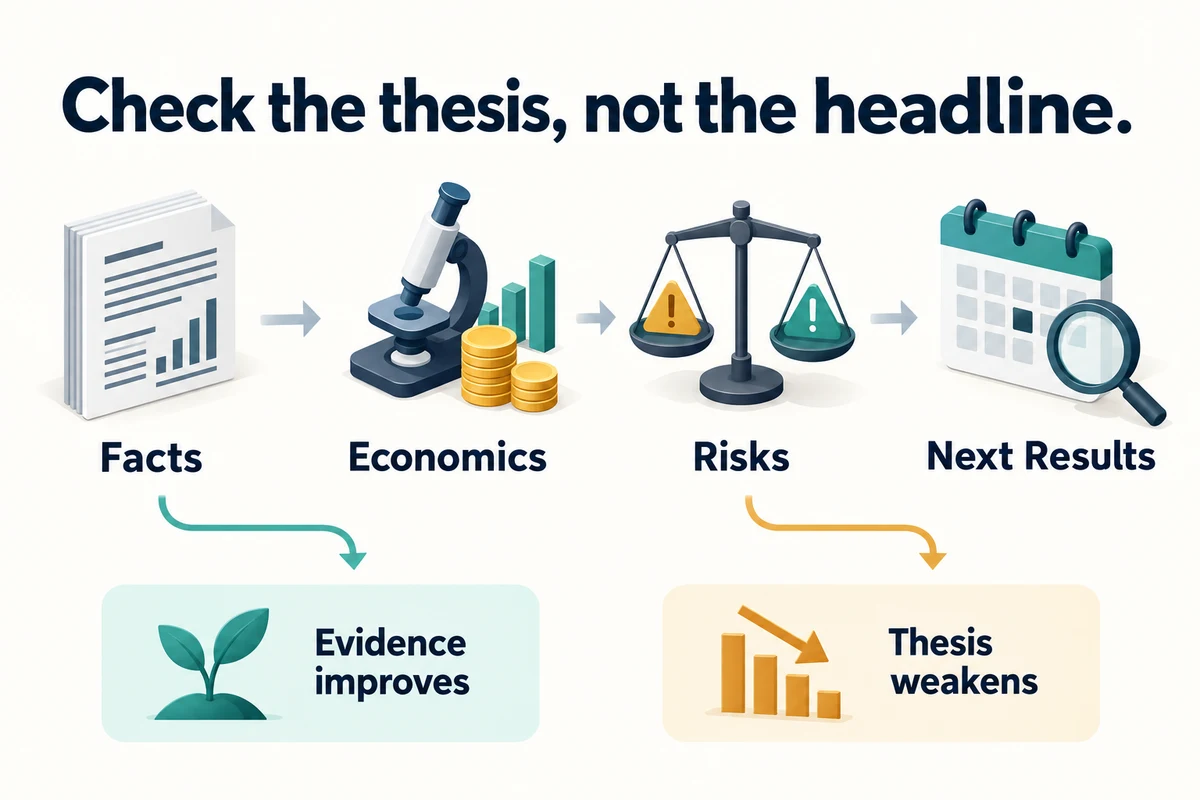
- Profitability: How have automotive pricing, product mix, costs, and operating margins changed?
- Earnings quality: Have non-operating income and expenses, taxes, stock-based compensation, and GAAP/non-GAAP adjustments been distinguished?
- Cash and investment: Have operating cash flow, capital expenditures, and working capital been compared over the same period?
- Energy: Do the timing of revenue recognition and profitability for installations meet expectations?
- Future businesses: Have confirmed paid usage and commercialization been distinguished from management's plans?
- Per-share value: Have increases in diluted share count and the risk of additional financing been accounted for?
- Price: Are the timestamp of the latest share price and the financial reporting period aligned, and does the assessment hold under different assumptions?
Does Tesla's share price rise when deliveries increase?
Not always. The market's existing expectations, selling prices and margins, future outlook, interest rates, and other factors all play a role. Deliveries exceeding expectations are one piece of information, not a buy signal.
Have third-quarter results already been released?
As of the date of this article, only production, delivery, and energy storage deployment figures had been disclosed. Financial results, including earnings and cash flow, are scheduled to be released after the U.S. market closes on 2026-10-21. The assessment should be updated after reviewing the actual published materials.
Should Tesla be valued solely on automotive company multiples?
It is more useful to separate cash generation and additional growth opportunities by business than to rely on a single classification. Unverified future earnings should not be treated as equivalent to confirmed earnings; the timing of realization, additional investment, competition, and regulatory risks should be taken into account.
Are tokenized Tesla products or equity-linked derivatives the same investment?
Not necessarily. Common shares held in a securities account and tokens or derivatives may differ in voting rights, dividend treatment, redemption, custody, and issuer risk. To distinguish product structures, see An explanation of the rights and risks of tokenized stocks. This article analyzes TSLA common stock.
Sources, scope of verification, and conflict-of-interest disclosure
- Primary sources: Tesla's third-quarter 2026 operational update linked in the article, the company's compiled estimates as of 2026-09-29, its third-quarter 2025 operational update, and Tesla's second-quarter 2026 SEC 10-Q.
- For upcoming earnings materials: Tesla Investor Relations. Company schedules and outlook may change.
- Cross-check with independent reporting: interactive investor's 2026-10-05 analysis, and Axios's 2026-10-02 report. The key figures and calculations in this article are based on primary sources; investment opinions from other media outlets have not been adopted wholesale.
- CoinPop's contribution: comparisons with estimates, the previous quarter, and the previous year; limitations in interpreting the difference between deliveries and production; the distinction between GAAP earnings and cash after investment; and valuation and scenarios with disclosed assumptions.
This article contains no exchange sign-up or affiliate CTA. It is an analysis based on company disclosures and does not rely on the author's holdings or investment experience. Stocks can result in loss of principal and are exposed to currency, business, competition, policy, regulatory, and management risks. The illustrative images are conceptual graphics created by CoinPop; they are not official company materials, actual screens, or proof of returns. When new official materials become available, the facts and verification date in this same document will be updated as needed.