

To be honest, when I first heard the name Hyperliquid, I thought it was just another DEX. New exchanges pour into the DeFi market every month, and most of them disappear within six months. But this one was different.
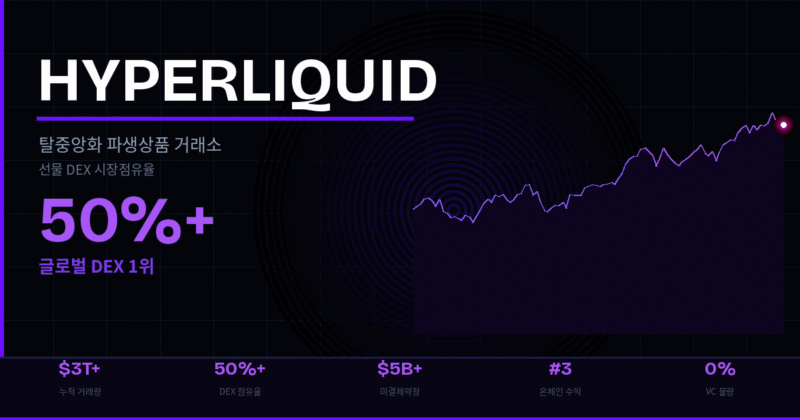
As of 2026, Hyperliquid alone accounts for over 50% of the decentralized derivatives exchange market share. The gap with the second-place Jupiter is 44 percentage points. It is not just the #1 DEX; it is climbing the global exchange rankings, overtaking mid-tier CEXs one by one.
Cumulative trading volume surpassed $3 trillion in early 2025, and in terms of on-chain revenue, it ranked 3rd among all blockchain protocols, following Tether and Circle. These numbers are hard to believe, but they are all verified on-chain data.
In this article, I will break down exactly what Hyperliquid is, how it works, and how to actually use it from start to finish. I won’t shy away from technical terms, but I will explain them in a way that is easy to understand.
What is Hyperliquid?
Hyperliquid is a decentralized derivatives exchange operating on its own Layer 1 (L1) blockchain. To define it in one sentence, it is an “on-chain financial ecosystem that combines the speed of centralized exchanges with the transparency of decentralization.”
The meaning of the name is also intuitive: “HYPER” + “LIQUID.” As the name suggests, it reflects the confidence that liquidity is overflowing.
The founding team consists of financial and technical experts from Harvard, MIT, and Caltech. Notably, this project did not receive a single penny of external venture capital (VC) investment. It was developed using internal funds and is structured to return most of the profits to the community. The fact that 70% of the total supply was allocated to the community when the HYPE token launched in November 2024 is an extension of this philosophy.
The operating entity is not fully disclosed, and the development team lead operates under the pseudonym “iliensinc.” While this might initially seem like a risk factor, all code and on-chain data are public, making it superior to many centralized exchanges in terms of transparency.
Key Metrics (as of 2026)
- Perp DEX Market Share: Over 50% (#1)
- Cumulative Trading Volume: Over $3 trillion
- Monthly Trading Volume: Approx. $200 billion
- Open Interest (OI): Over $5 billion
- On-chain Revenue Ranking: 3rd among all blockchain protocols
- Supported Assets: Over 500 perpetual futures markets
What makes it different from other DEXs?
When people think of a DEX, many think of an AMM (Automated Market Maker) like Uniswap. In the Uniswap model, smart contracts automatically calculate prices and process trades based on liquidity locked in pools. While simple and scalable, it has drawbacks.
Slippage is high. Gas fees are attached to every trade. It is structurally unsuitable for complex derivatives like perpetual futures. Crucially, it does not use the Order Book method that traditional financial traders are accustomed to.
Hyperliquid tackled this problem head-on.
On-chain Order Book
Hyperliquid implemented the Central Limit Order Book (CLOB) system used in CEXs directly on the blockchain. Every order is recorded on-chain, and maker-taker matching also occurs within the chain. You don’t have to trust the trade results; you can verify them yourself directly on the blockchain.
Gas-free Trading
There are no Ethereum gas fees attached to every trade. You need a small amount of gas once when activating your wallet for the first time, but thereafter, individual trades do not incur gas fees. Anyone who has used a DEX in the Ethereum ecosystem will immediately understand how massive a difference this makes in user experience.
No KYC Required
Performing identity verification (KYC) on CEXs like Binance or Bybit takes time and providing personal information is burdensome. On Hyperliquid, you can trade immediately by just connecting your wallet. There is no separate account registration or email verification. Your wallet address is your account.
Transparent Redistribution of Fee Revenue
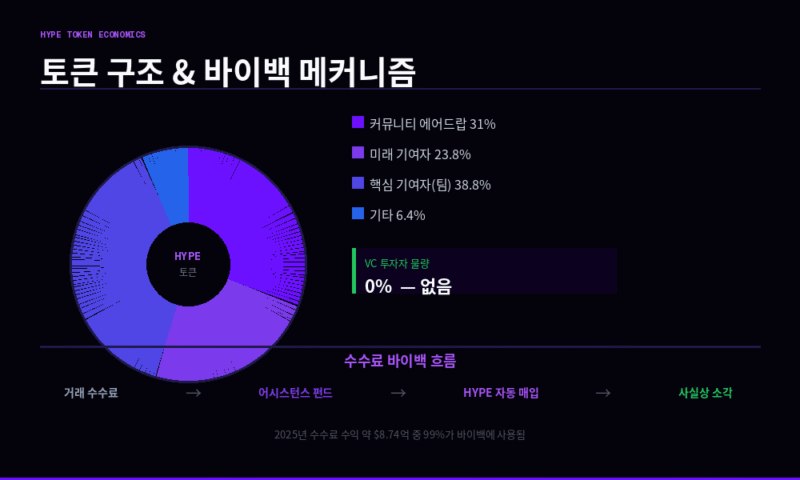
CEXs take trading fees as company profit. Hyperliquid uses over 90% of its fee revenue for HYPE token buybacks. This flow is entirely disclosed on-chain. According to Cantor Fitzgerald’s analysis, 99% of the roughly $874 million in fees generated by Hyperliquid through 2025 was used for buybacks.
Technical Architecture – HyperCore, HyperEVM, HyperBFT
To understand where Hyperliquid’s performance comes from, you have to look at its technical structure. I’ll explain it without being too complex.
HyperBFT – Consensus Algorithm
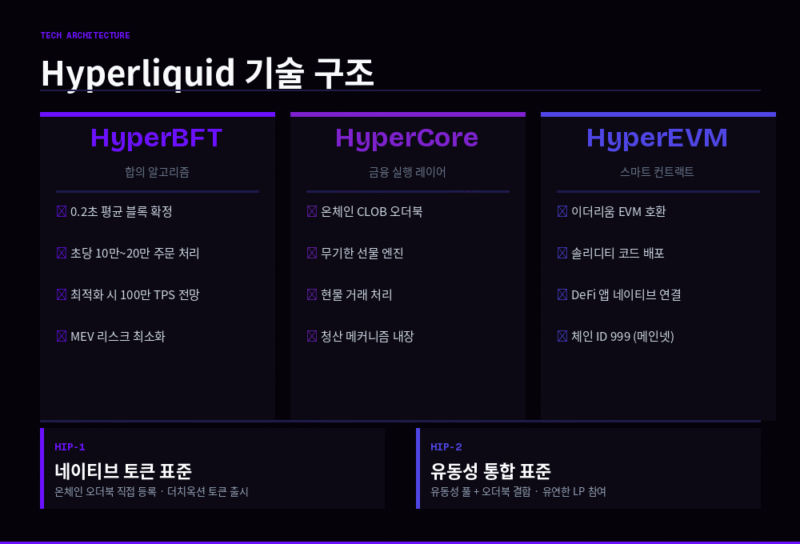
Hyperliquid uses its own consensus algorithm called HyperBFT. It is an optimized version based on Hotstuff technology. Thanks to this, block finality latency is a median of 0.2 seconds, and even the 99th percentile is within 0.9 seconds. Simply put, trades are completed in less than a second after placing an order.
Processing performance averages 100,000 to 200,000 orders per second, with a theoretical maximum estimated at over 1 million per second. These figures are overwhelming even compared to existing DEXs on Ethereum or Solana.
HyperCore – Financial Engine
HyperCore is the financial layer of Hyperliquid. Perpetual futures, spot trading, order books, and liquidation mechanisms all run here. It is a dedicated execution environment fully optimized for financial logic.
HyperEVM – Smart Contract Layer
HyperEVM is a smart contract environment compatible with the Ethereum Virtual Machine (EVM). It was added to the mainnet in early 2025. Developers can deploy existing Solidity code directly on Hyperliquid, and Ethereum ecosystem wallets and tools are compatible. Since HyperEVM can read HyperCore’s financial data, DeFi apps like lending protocols and tokenized vaults can be linked with native perpetual liquidity.
HIP-1, HIP-2 – Token Standards
HIP-1 is the Hyperliquid native token standard, which allows tokens to be registered directly on the on-chain order book. HIP-2 is a structure that integrates liquidity pools and order books, allowing liquidity providers to participate more flexibly. Thanks to this, initial liquidity for new token launches is established via a Dutch Auction.
Full Analysis of HYPE Token
Another core factor that distinguishes Hyperliquid from other DEXs is the economic structure of the HYPE token. It is not a simple governance token.
Largest Airdrop in History
On November 29, 2024, the HYPE token was officially launched. On that day, 31% of the total supply was airdropped to early users, and 23.8% was allocated to community contributors. According to the development team, a total of approximately 270 million HYPE were released at the time of the airdrop, which was worth about $9.5 billion (approx. 13 trillion KRW) based on the market price at the time. It is one of the largest airdrops in crypto history. It carried even more weight because it was a reward given to people who actually used the Hyperliquid DEX during the points campaign period.
The Role of HYPE
The HYPE token performs three core functions.
- Staking: Validators responsible for the security of the HyperBFT consensus algorithm stake HYPE. Staking rewards are distributed, providing the basis for decentralized network operation.
- Gas Token: HYPE is used as gas fees when executing smart contracts on HyperEVM. Base fees are burned via the EIP-1559 mechanism.
- Governance: Exercising voting rights on protocol changes, upgrades, validator voting, etc.
Assistance Fund – Price Defense Mechanism
This is the most unique part of Hyperliquid’s tokenomics. Most of the trading fee revenue is routed to a system address called the Assistance Fund, which automatically buys back HYPE. This fund is designed without specific keys, meaning no one can withdraw funds from it.
As of December 2025, approximately $1 billion worth of HYPE has accumulated in this address. The Hyper Foundation officially categorized this volume as non-circulating assets through a validator vote. In effect, it has the same effect as burning. The continuous accumulation of tokens that are not supplied to the market forms structural support for the price in the long term.
HYPE Token Distribution Structure
- Community Airdrop (Genesis): 31%
- Future Community Contributors: 23.8%
- Core Contributors (Team): Remainder – 0.08% daily linear vesting starting November 29, 2025
- VC Investor Allocation: 0% (None)
The absence of VC allocation is a significantly important point. Many projects experience price corrections whenever VC allocations unlock. Hyperliquid structurally lacks that risk.
Fee Structure
Hyperliquid’s fees are among the lowest in the industry. Combined with the absence of gas fees, the actual trading cost is significantly lower than that of CEXs.
Perpetual Futures Fees
- Maker: 0.010%
- Taker: 0.035%
Spot Fees
- Maker: 0.020%
- Taker: 0.050%
A maker is an orderer who places a limit order on the order book, while a taker is the one who fills an existing order. By making a habit of using limit orders, you can reduce fees by nearly half.
Referral Discount
If you sign up through a referral code, a 4% discount is permanently applied to all trading fees. It may seem like a small amount, but as trading frequency increases, the cumulative savings effect becomes significant.
Flow of Fee Revenue
Trading fees are distributed as follows: HLP (Liquidity Provision Vault) takes a portion, and the rest leads to HYPE buybacks via the Assistance Fund. The structure ensures that as more fees are paid, the scarcity of the HYPE you hold increases.
Actual Usage – From Deposit to First Trade
Hyperliquid has no KYC and no account registration. You just need a wallet. Even a first-timer can complete their first trade within 10 minutes.
Preparation
- MetaMask or a wallet that supports the Arbitrum network
- USDC on the Arbitrum network (for deposit)
- A small amount of ETH on the Arbitrum network (Initial gas fee of about $0.06)
Step 1: Connect Wallet
After accessing the official Hyperliquid site (app.hyperliquid.xyz), click the ‘Connect’ button in the top right. When the wallet selection window appears, select MetaMask and approve the connection. After connecting, click the ‘Enable Trading’ button to activate gas-free trading mode.
Step 2: Deposit USDC
In the ‘Deposit’ tab, enter the amount of USDC to deposit and approve it in MetaMask. Arbitrum network ETH is consumed for the gas fee, which is around $0.06. Deposited USDC basically goes into the Perps wallet. To do spot trading, use the ‘Transfer to Spot’ button to transfer it to the spot wallet.
Step 3: Deposits possible from other chains like Solana
Initially, only Arbitrum USDC was supported, but now deposits are possible from various assets and chains. Solana users can also deposit via bridge.
Step 4: Perpetual Futures Trading
Select the asset you want to trade from the left menu to bring up the order book screen. Set the leverage ratio and enter a limit or market order. TP (Take Profit)/SL (Stop Loss) settings can also be entered during the order.
For first-time traders, it is recommended to set leverage low (2-5x) and keep position sizes small. Because Hyperliquid assets themselves move quickly, there is sufficient volatility even without leverage.
Step 5: Withdrawal
Withdrawals are handled in the ‘Withdraw’ tab. You just need to sign in MetaMask. Withdrawal processing is generally completed within a few minutes.
Vaults and HLP Features
Hyperliquid has structures that allow you to earn profit beyond simple trading. These are the Vaults.
HLP – Hyperliquid Liquidity Provider
HLP (Hyperliquid Liquidity Provider) is Hyperliquid’s official protocol vault. When a user deposits USDC, HLP uses those funds for market making and liquidation processing. The structure is that depositors share a portion of the trading fees.
It is suitable for people who find it difficult to create direct trading strategies or do not have time. However, since HLP also holds positions, losses can occur depending on market conditions. One must clearly recognize that principal is not guaranteed.
Community Vaults
Besides HLP, there are community vaults operated by individual traders or algorithms. The ROI, Maximum Drawdown (MDD), and operating period of each vault are all public. Vault operators take up to 10% of the profit as fees, and depositors take the rest. It is a highly transparent structure.
Risks and Controversy – The JELLYJELLY Incident
I’m not trying to say Hyperliquid is perfect. In March 2025, there was an incident where this exchange was caught in a heated controversy. It’s only fair to report it as it is.
The JELLYJELLY Incident
The incident began when a user heavily shorted the meme coin JELLYJELLY on Hyperliquid. This user closed part of the position and withdrew approximately $2.76 million in collateral. Subsequently, as the JELLYJELLY price skyrocketed, the unrealized loss of the remaining short position ballooned to about $10 million.
With the dedicated liquidation system account holding this position, Hyperliquid, after consulting with validators, suspended JELLYJELLY futures trading and forcibly closed the user’s position at a specific price.
While the loss was eventually mitigated, criticism poured in. The argument was that a “decentralized exchange forcibly intervened in a user’s position.” The CEO of Bitget publicly pointed out that the “structural flaws are serious.” In the few hours following the incident, about $140 million in USDC was withdrawn from Hyperliquid.
Lessons from this Incident
Hyperliquid used this incident as an opportunity to strengthen its margin management rules. However, the structural dilemma remains: the fact that collective decision-making to protect the entire system under extreme market conditions can clash with the principles of decentralization. This is not just a Hyperliquid issue but a fundamental challenge faced by all decentralized finance systems.
What’s important from an investor’s perspective is that they did not hide this incident and responded with on-chain data and open communication. Furthermore, trading volume and OI showed a recovery trend thereafter.
Other Risk Factors
- Smart Contract Vulnerabilities: No on-chain protocol is 100% free from bugs.
- Validator Concentration Risk: If a small number of validators control the network, the level of decentralization could decrease.
- Regulatory Uncertainty: There is a possibility that regulations against platforms offering derivatives trading without KYC will be strengthened.
- Team Anonymity: Since the development team is anonymous, there is uncertainty regarding long-term operational sustainability.

Hyperliquid vs. Centralized Exchanges
So, should you use Hyperliquid instead of CEXs like Binance or Bybit? Or should you use them side-by-side? Let’s compare them directly.
| Feature | Hyperliquid | Major CEX (Binance, etc.) |
|---|---|---|
| Asset Storage | Directly in wallet (Non-custodial) | Stored on exchange (Custodial) |
| KYC | Not required | Mandatory |
| Transparency | All trades disclosed on-chain | Internal processing, limited disclosure |
| Trading Fees | Maker 0.01%, Taker 0.035% | Maker 0.02%, Taker 0.05% |
| Gas Fees | None | None |
| Deposit/Withdrawal Speed | On-chain processing (minutes) | Fast (Instant to minutes) |
| Leverage | Max 50x (varies by asset) | Max 125x |
| Liquidity | #1 DEX, Mid-tier CEX level | Industry top-tier |
| Hacking Risk | Smart contract risk | Exchange hacking risk |
| Fee Revenue Attribution | HYPE buyback (Community) | Exchange (Shareholders) |
The conclusion is not simple. If you want to maintain control over your asset storage and on-chain transparency is important, Hyperliquid has the advantage. If you need extremely high leverage or access to a very wide range of altcoins, CEXs are still more abundant. Many traders use both side-by-side.
For reference, CoinPopBit referral links for major CEXs can be found below.
- Binance 20% fee discount: https://coinpopbit.com/en/about-binance-exchange-2026/
- Bybit 20% fee discount: https://coinpopbit.com/en/bybit-en/
- Bitget 50% fee discount: https://coinpopbit.com/en/bitget-en/
- OKX 20% fee discount: https://coinpopbit.com/en/okx-exchange-introduction-2026/
Frequently Asked Questions
Q1. In which countries can Hyperliquid be used?
하이퍼리퀴드는 탈중앙화 프로토콜이라 공식적으로 특정 국가를 제한하지 않는다. 다만 미국 IP에서는 일부 기능 접근이 제한되는 경우가 있다. 각 국가의 암호화폐 관련 법규에 따라 이용 가능 여부가 달라질 수 있으므로 현지 법령을 확인하는 것이 좋다.
Q2. Can I trade Bitcoin directly on Hyperliquid?
It is not a method of directly holding Bitcoin spot. You can take a position on the direction of Bitcoin’s price through Bitcoin perpetual futures (BTC-USDC Perp). Since USDC is used as collateral, there is no need to deposit Bitcoin itself.
Q3. Where can I buy HYPE tokens?
You can purchase directly with USDC on Hyperliquid’s own spot market. It is also tradable on centralized exchanges like Bybit and Gate.io.
Q4. What is the HYPE staking yield?
The staking APY fluctuates depending on network status and validator settings. It is most accurate to check the latest yield on the official Hyperliquid site.
Q5. In what cases can I lose funds on Hyperliquid?
If liquidation occurs in leverage trading, you can lose your entire collateral. HLP vaults are not principal-guaranteed and incur losses depending on market conditions. Also, the possibility of smart contract bugs or hacking is not zero. It is basic practice to only manage amounts you can afford to lose.
Q6. There was news about a Hyperliquid HYPE ETF, what happened with that?
In December 2025, Bitwise Asset Management applied for a HYPE ETF (Ticker: BHYP) with the US SEC. The application included an annual management fee of 0.67% and plans for on-chain staking of HYPE tokens. The approval of the ETF depends on the SEC’s decision, and if approved, institutional funds could flow into Hyperliquid in earnest.
Conclusion – Who is Hyperliquid right for?
Hyperliquid is not just a simple trend. 50% DEX market share, $3 trillion cumulative volume, 3rd in total on-chain revenue. These numbers are results created by actual users, not speculative expectations.
It is particularly well-suited for the following types of people:
- People who want to trade futures while storing assets directly in their own wallets
- People who want to start quickly without KYC
- People who are uneasy about CEX hacking or insolvency risk
- People who agree with the structure where fee revenue returns to the community
- People who find investment appeal in the HYPE token buyback mechanism
Conversely, CEXs are still better in some cases: when extremely high leverage is required, when spot trading of hundreds of altcoins is the primary goal, or when direct fiat deposits are necessary. If you are a beginner still unfamiliar with smart contract risks or on-chain trading, building experience on a CEX first is also a valid method.
Hyperliquid is still growing. The integration of Ripple Prime, HYPE ETF application, and increasing interest from institutional investors are ongoing. People who understood and participated in this trend early enjoyed the greatest benefits, and that opportunity remains open.
Check CoinPopBit for more detailed exchange comparison information: https://coinpopbit.com/en/coin-exchange-rankings/
This post was written for informational purposes and is not investment advice. Since cryptocurrency trading and DeFi participation carry the risk of principal loss, thorough prior research and prudent judgment are required.
