

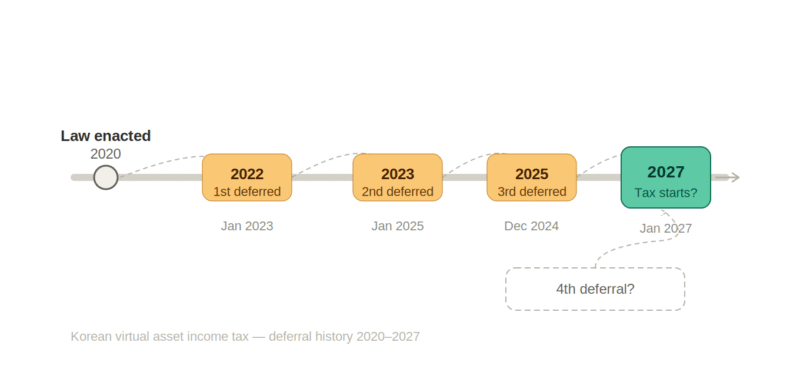
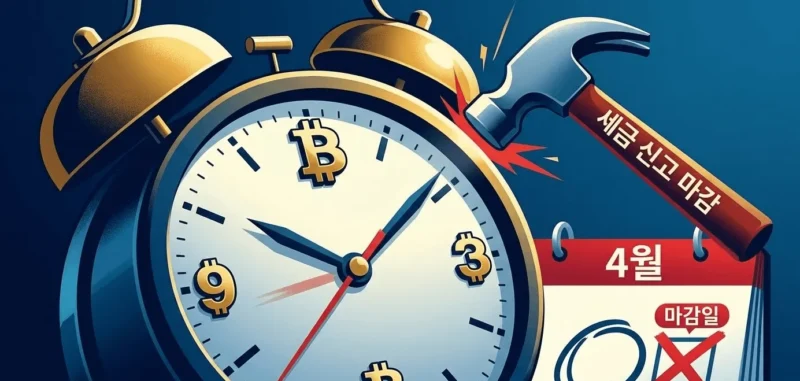
As of 2026, there is one topic that is undoubtedly the hottest among crypto investors: “Is crypto really going to be taxed starting January 2027?” To give you the conclusion first, under the current Income Tax Act, the implementation of taxation on January 1, 2027, is legally confirmed. However, the situation is far from settled as debates over another postponement are flaring up within political circles.
In this article, we will break down the tax structure, tax rates, political debates, the possibility of a fourth postponement, and how investors should prepare right now.
The Long History of Crypto Taxation, Postponed Three Times
Bitcoin taxation in 2027 is not a new story. It was first introduced through an amendment to the Income Tax Act in 2020, with an initial target of implementation in January 2022. However, it has been delayed three times since then.
- 1st Postponement (2021): Delayed to 2023 due to a lack of taxation infrastructure.
- 2nd Postponement (2022): Delayed to 2025 citing virtual asset market conditions and the need to refine investor protection systems.
- 3rd Postponement (December 2024): Confirmed for January 2027, citing the need to review the performance of the Virtual Asset User Protection Act and refine the CARF.
In effect, the law has been on the books for over five years without a single tax being collected. The Korea Capital Market Institute has pointed out that “it is difficult to find such cases in major countries.”
What is the Tax Rate? Understanding the 22% Structure
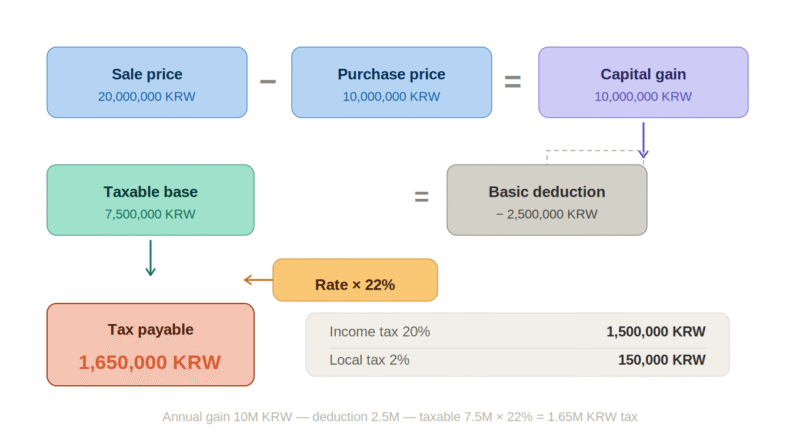
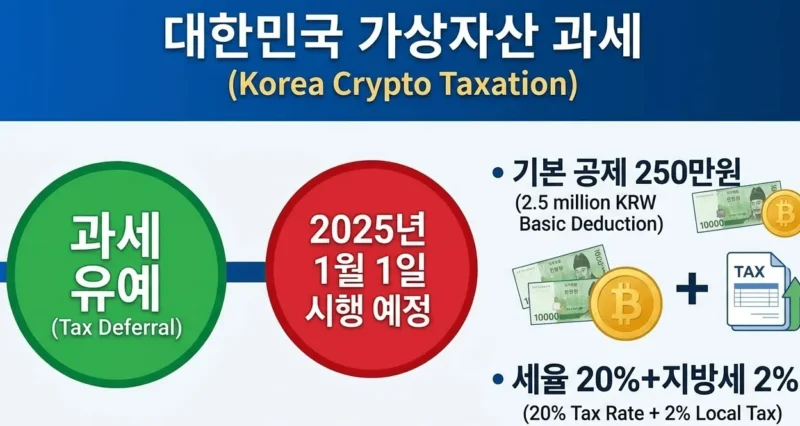
People often refer to the “22% crypto tax rate.” To be precise, this is the sum of 20% other income tax + 2% local income tax.
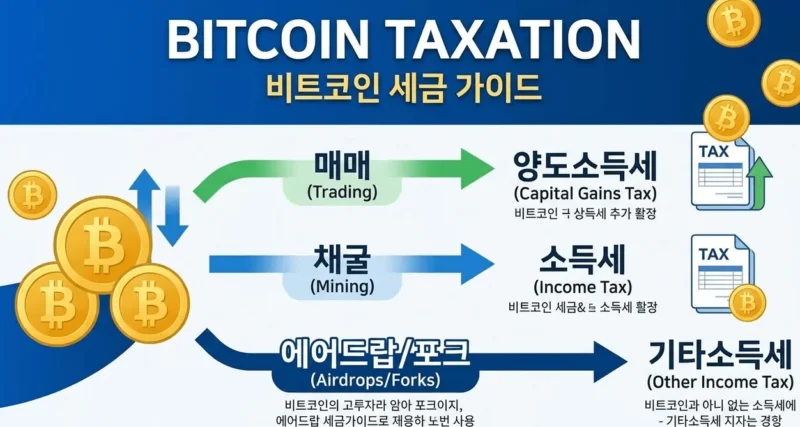
The tax applies to income generated from transferring or lending virtual assets. It is calculated by netting gains and losses over one year, and a basic deduction of 2.5 million KRW per year is applied.
Example of Actual Tax Calculation
| Item | Amount |
|---|---|
| Acquisition Cost (Purchase Price) | 10 million KRW |
| Transfer Price (Sale Price) | 20 million KRW |
| Capital Gain | 10 million KRW |
| Basic Deduction | −2.5 million KRW |
| Tax Base | 7.5 million KRW |
| Tax Payable (×22%) | 1.65 million KRW |
The Must-Know Acquisition Cost Deeming Provision
For coins held before January 2027, the acquisition cost will be recognized as the higher of the market price as of December 31, 2026, or the actual acquisition cost. If you bought coins cheaply a long time ago, this provision could significantly reduce your tax burden.
However, the carry-forward deduction for losses is not currently reflected in the bill. This means that if you lose money this year, you cannot deduct it from next year’s profits. This is one of the core points of contention regarding fairness compared to stock taxation.
What is Being Discussed in Political Circles?
While the official stance is “implementation confirmed for 2027,” the atmosphere within political circles is completely different.
Im I-ja, Chair of the National Assembly Strategy and Finance Committee, has openly mentioned that “the possibility of another postponement is high.” The core argument is the voter structure. The domestic virtual asset trading population is approximately 7 million, and 47% of them are under the age of 30. Add to this the political variable of the 2026 local elections. Analysts suggest that politicians, mindful of the youth vote, have sufficient incentive to delay taxation once again.
The moves of the Democratic Party of Korea are also noteworthy. The Democratic Party made ‘postponement of virtual asset taxation’ a campaign pledge during the presidential election and actually agreed to the third postponement. This is why critics argue that political calculations are taking precedence over principles. Even now, with a change in administration, they have not issued an official position to actively push for taxation.
On the other hand, experts have a different view. Kim Gap-rae, a senior research fellow at the Korea Capital Market Institute, warned that “a fourth postponement could completely destroy policy credibility.” Lawyer Kim Ik-hyun of Yulchon LLC also pointed out the problem of institutional inadequacy, stating, “After the martial law and early presidential election, improvements to the tax system have come to a complete standstill.”





4 Key Inadequacies in the Current Bill
- No Carry-Forward Deduction for Losses: Unlike stocks, crypto losses cannot be carried over to the next year. Critics call this asymmetric taxation.
- Unclear Acquisition Cost Calculation Criteria: The criteria for calculating the acquisition cost of coins bought in the past remain ambiguous.
- Equity with Overseas Exchanges: The issue of whether users of overseas exchanges like Binance and Bybit can be taxed the same as users of domestic exchanges.
- Lack of Criteria for Airdrops/Staking: There are no tax standards for income earned from blockchain validation rewards, airdrops, or hard forks.
The Ministry of Economy and Finance is scheduled to decide on whether to postpone in the tax law amendment bill in July 2026. This point in time is effectively the turning point for a fourth postponement.
CARF Surveillance Network Active: Overseas Exchanges Are Now Visible
Regardless of the debate over tax postponement, an irreversible trend has already begun. That is the CARF (Crypto-Asset Reporting Framework).
Starting January 1, 2026, the top 5 domestic exchanges, including Upbit, Bithumb, and Coinone, began mandatorily collecting self-certification forms for customers’ overseas tax obligations. This is a measure in accordance with a multilateral agreement participated in by 48 OECD countries, including South Korea.
Transaction information collected throughout 2026 will be reported to the National Tax Service by the end of April 2027 and subsequently shared automatically with signatory countries. It is a structure where the transaction history of a Korean investor on Binance is passed to the Korean National Tax Service through the authorities of that country.
The idea that “they won’t know if I use an overseas exchange” no longer holds any water. You should consider that transactions from 2026 onwards are within the National Tax Service’s surveillance network.
As the taxation infrastructure is effectively nearing completion, the justification for postponement based on “lack of infrastructure” is also weakening.
So, Will There Be a 4th Postponement?
To be honest, it is difficult to be 100% sure either way. However, if we calmly weigh the arguments at this point, they are as follows.
🔴 Factors Increasing the Possibility of Postponement
- Political sensitivity to the voter base due to the 2026 local elections.
- Im I-ja, Chair of the Strategy and Finance Committee, personally stated in public that “the possibility of postponement is high.”
- Inadequacies in the bill, such as carry-forward deductions and acquisition cost calculations, have not yet been resolved.
- The atmosphere of maintaining a tax reduction stance in the early stages of the current administration.
🟢 Factors Increasing the Possibility of Implementation
- The CARF infrastructure is operational, weakening the argument that “we are not ready.”
- Experts from the Capital Market Institute and the legal community are strongly warning against the collapse of policy credibility in the event of a 4th postponement.
- Developed countries such as the US, Japan, and Germany are already implementing crypto taxation.
- It is difficult for the government to give up tax revenue from transactions estimated at 160 trillion KRW per year.
The most realistic scenario is not a complete postponement, but rather implementation in 2027 combined with conditional improvements such as raising the deduction limit (from 2.5 million KRW to 5 million KRW or more) or allowing carry-forward deductions for losses. The announcement of the Ministry of Economy and Finance’s tax law amendment in July 2026 is the de facto turning point.
Comparison with Major Overseas Countries: Is Korea Uniquely Late?
While Korea has been continuously delaying crypto taxation, what have other countries done?
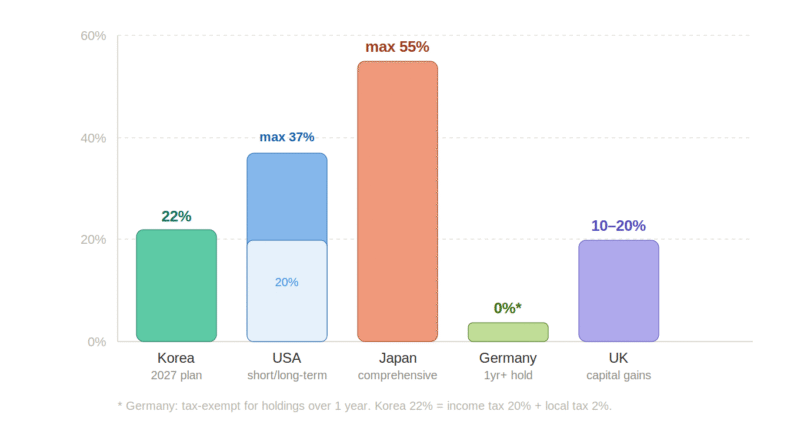
| Country | Tax Method | Tax Rate | Implementation Status |
|---|---|---|---|
| Korea | Other Income Tax | 22% (incl. local tax) | Scheduled for 2027 |
| USA | Capital Gains Tax | Short-term max 37% / Long-term max 20% | Implemented |
| Japan | Comprehensive Income Tax | Max 55% | Implemented |
| Germany | Capital Gains Tax | Tax-free if held for over 1 year | Implemented |
| UK | Capital Gains Tax | 10~20% | Implemented |
Comparing them, Korea’s 22% tax rate itself is at a mid-level by global standards. The problem is the lack of carry-forward deductions for losses and the ambiguity of criteria for various types of income such as staking and airdrops. The completeness of the system is a bigger task than the tax rate itself.
Things Investors Should Do Now Before Taxation
Whether it is postponed or not, it is right to prepare from now. Regret always comes later.
- Start Organizing Transaction History Immediately: Keep meticulous records of which exchange you bought on, when, at what price, and when and at what price you sold. Records of transfers to personal wallets may also be subject to requests for explanation later.
- Check Market Price on December 31, 2026: According to the acquisition cost deeming provision, you can use the higher of the market price on this day or the actual acquisition cost as the acquisition cost. For coins held for a long time, the year-end price becomes the benchmark for tax calculation.
- Understand Annual Net Profit/Loss Structure: You need to get into the habit of calculating not just vaguely “I made a lot,” but whether you actually made more than 2.5 million KRW in annual profit and what your actual profit is after offsetting losses.
- If You Use Overseas Exchanges, Awareness of CARF is Essential: Information from 2026 transaction history can flow to the National Tax Service. The idea that “I don’t have to pay Korean taxes on Binance or Bybit” is now dangerous.
You can check fee discount codes and usage guides for major overseas exchanges below.
- Binance Guide and 20% Fee Discount: https://coinpopbit.com/binance/
- Bybit Guide and 20% Fee Discount: https://coinpopbit.com/bybit/
- Bitget Guide and 50% Fee Discount: https://coinpopbit.com/bitget/
- OKX Guide and 20% Fee Discount: https://coinpopbit.com/okx/
Is Crypto Investment Still Worth It?
Even assuming taxation is implemented, many believe that the appeal of virtual asset investment will not diminish significantly.
Until 2026, it is a tax-free period. Profits generated during this period are not taxed. Even if taxation starts in 2027, there is a 2.5 million KRW annual deduction, and a 22% tax rate is not a bad level by global standards.
Even compared to stocks, the volatility and upside potential of crypto remain unmatched. It is a market where variables such as Bitcoin halving cycles, altcoin seasons, and institutional capital inflows are alive. If the profits are overwhelmingly large, the investment appeal is sufficiently maintained even if you pay taxes.
However, the concept of after-tax return is now becoming important. When you make a profit, you need to get into the habit of calculating the actual net profit after taxes, rather than just looking at the sale price. This is also part of the process of becoming a mature investor.
You can check the real-time status of the Kimchi Premium and market capitalization rankings of major domestic exchanges below.
- Real-time Kimchi Premium Check: https://coinpopbit.com/kimp/
- Virtual Asset Market Cap Ranking: https://coinpopbit.com/top-assets-ranking/
- Exchange Ranking Comparison: https://coinpopbit.com/exchange-ranking/
Conclusion: 2026, Those Who Prepare Have the Advantage
It is difficult to conclude right now whether Bitcoin taxation in 2027 will “happen or not.” Political calculations remain, and the announcement of the Ministry of Economy and Finance’s tax law amendment in July 2026 will be the decisive turning point.
However, two things are certain. First, the CARF surveillance network is already operational. Second, the direction of taxation itself is an already determined trend.
It is highly likely that 2026 is the last tax-free period provided institutionally. How you utilize this opportunity is entirely up to each investor. The gap between those who prepare and those who stand by will widen even further once taxes begin to be applied.